REQUEST A FREE ESTIMATE!
What Is an Accumulation Conveyor and Why Is It Important
What Is an Accumulation Conveyor? Functions and Benefits in Modern Production Lines
In modern manufacturing environments, efficiency is not determined solely by machine speed. It also depends on how well the entire production line operates as a synchronized system. When one machine slows down or temporarily stops, the impact can spread throughout the line and reduce overall productivity.
To address this challenge, many manufacturers implement an accumulation conveyor system as part of their production optimization strategy. This system helps maintain product flow, reduce bottlenecks, and improve overall line efficiency.
Across food and beverage, pharmaceutical, cosmetic, FMCG, and personal care industries, accumulation conveyors have become an essential component in filling lines, bottling lines, and packaging lines.
What Is an Accumulation Conveyor System?
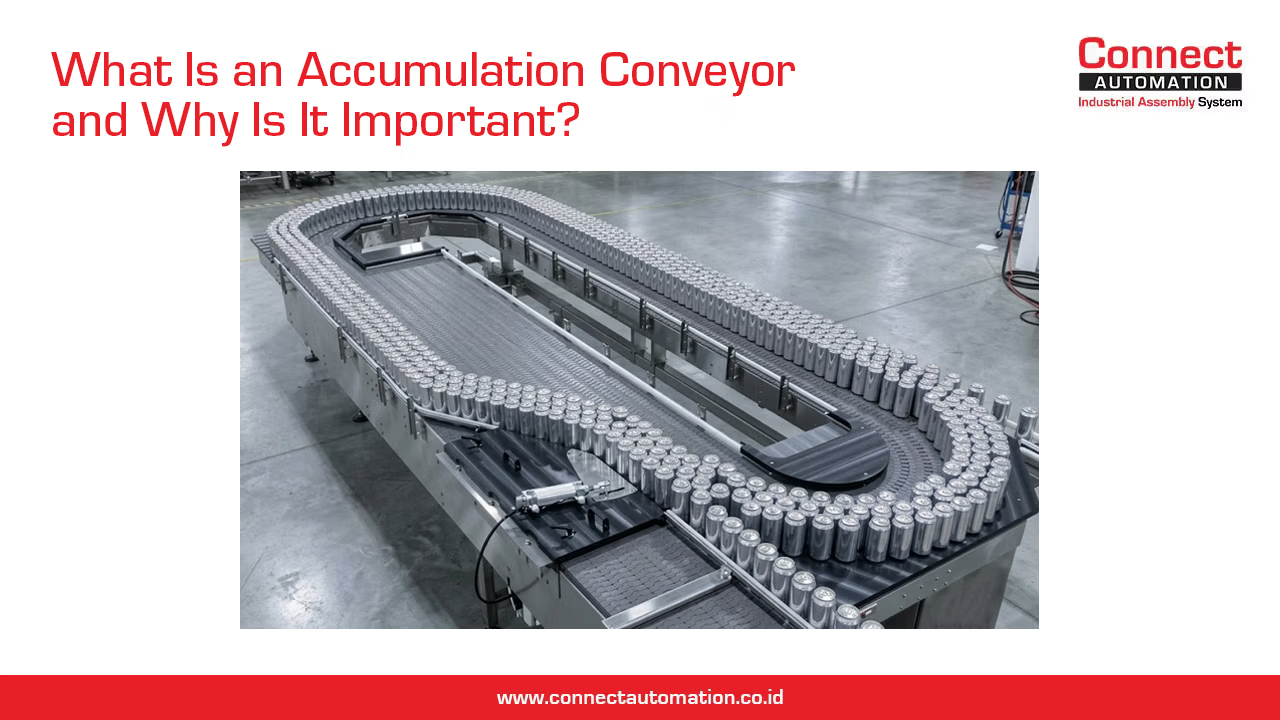
An accumulation conveyor is a conveyor system designed to provide temporary buffer space for products moving through a production line.
Unlike a standard conveyor that simply transfers products from one point to another, an accumulation conveyor allows products to be temporarily stored when there are speed differences between machines or when a downstream process experiences a short interruption.
For example, in a typical filling line:
Unscrambler → Filling Machine → Accumulation Conveyor → Labeling Machine → Packaging
If the labeling machine stops for a few minutes to replace a label roll, the accumulation conveyor can temporarily hold products, allowing the filling machine to continue operating without immediately stopping. This approach creates a more flexible and efficient production flow.
Why Do Bottlenecks Occur in Production Lines?
One of the most common challenges in automated manufacturing systems is the occurrence of bottlenecks. A bottleneck occurs when one process has a lower capacity than the processes before it, restricting the flow of products through the production line.
1. Different Machine Speeds
Each machine within a production line may operate at a different speed. For example:
- Filling machine: 200 bottles per minute
- Labeling machine: 180 bottles per minute
Without a buffer zone, products will begin accumulating before the labeling machine, eventually affecting upstream operations.
2. Temporary Downtime
Production equipment may occasionally stop due to routine operational activities such as:
- Label roll replacement
- Packaging material changeovers
- Equipment cleaning
- Minor maintenance
- Quality inspections
Although these interruptions may only last a few minutes, repeated short stoppages can significantly impact daily production output.
3. Product Build-Up
Without an accumulation system, product build-up can quickly force upstream equipment to stop because there is no available space for additional products to move forward. As a result, overall production efficiency decreases.
How Does an Accumulation Conveyor Work?
The operating principle of an accumulation conveyor is relatively straightforward. The system provides temporary storage capacity within the conveyor line, allowing products to continue moving or be held temporarily when production flow becomes unbalanced. When a downstream machine slows down or stops:
- Products are directed into the accumulation zone.
- The conveyor temporarily stores a defined number of products.
- Upstream equipment can continue operating as long as accumulation capacity remains available.
Once the downstream machine resumes normal operation:
- Stored products are gradually released.
- Production flow returns to normal without stopping the entire line.
This approach minimizes the impact of localized downtime on overall production performance.
Benefits of an Accumulation Conveyor System
1. Reducing Production Downtime
One of the primary benefits of an accumulation conveyor is its ability to reduce the impact of temporary machine stoppages. Short interruptions that would normally stop the entire production line can be absorbed by the accumulation buffer.
2. Keeping Upstream Equipment Running
Machines such as:
- Unscramblers
- Filling machines
- Depalletizers
- Sorting systems
can continue operating even when downstream equipment experiences temporary interruptions. This helps maximize production uptime.
3. Improving Overall Equipment Effectiveness (OEE)
By reducing stoppages and maintaining production continuity, accumulation conveyors contribute to improved OEE through:
- Higher availability
- Better performance
- Reduced operational disruptions
4. Minimizing Product Loss
Uncontrolled product accumulation can lead to damaged packaging, fallen products, or production interruptions. An accumulation conveyor helps manage product flow in a controlled and efficient manner.
5. Maintaining Stable Product Flow
Accumulation systems create a better balance between different production processes, helping the entire line operate more smoothly and efficiently.
Common Types of Accumulation Systems
Several accumulation methods are commonly used in modern manufacturing environments.
1. Mass Accumulation
In a mass accumulation system, products come into direct contact with one another while accumulating. This method is commonly used for:
- Plastic bottles
- Glass bottles
- Cans
- FMCG products
Mass accumulation is often selected for high-volume production environments due to its simplicity and cost-effectiveness.
2. Low-Pressure Accumulation
Low-pressure accumulation is designed to minimize product-to-product pressure during accumulation. This approach is commonly used for:
- Pharmaceutical products
- Cosmetic products
- Premium packaging
- Personal care products
3. Dynamic Accumulation
Dynamic accumulation is a more advanced solution that actively manages product flow to maximize buffer capacity while maintaining smooth product movement. It is frequently used in high-speed production lines where maximum efficiency is required.
Why Is FlexLink Widely Used for Accumulation Conveyor Systems?
In modern accumulation conveyor applications, FlexLink Table Top Chain Conveyor systems have become one of the preferred solutions across multiple industries. FlexLink is not simply a conveyor for product transfer. It is designed to support intelligent product flow management while maximizing production efficiency.
One of the key advantages of FlexLink is its ability to create large accumulation capacities without requiring excessive floor space. By combining straight sections and curves, FlexLink systems can achieve longer accumulation paths within a compact footprint. This makes it particularly valuable for facilities where production space is limited but buffer capacity is essential.
1. Flexible Layout Design
FlexLink systems can be configured to accommodate various production layouts, including:
- Straight conveyor sections
- Horizontal curves
- Elevation changes
- Complex machine integrations
2. Ideal for High-Speed Production Lines
FlexLink is widely used in high-capacity manufacturing environments because it maintains smooth and reliable product flow even under dynamic operating conditions.
3. Easy Integration with Filling and Packaging Equipment
FlexLink conveyor systems can be integrated with:
- Filling machines
- Capping machines
- Labeling machines
- Cartoning machines
- Packaging systems
This enables seamless product movement throughout the production process.
4. Compatible with Multi-Lane Conveyor Systems
In many applications, accumulation conveyors are combined with multi-lane conveyor systems to increase buffer capacity while optimizing product flow toward a single downstream process.
5. Designed for Hygienic Industries
FlexLink is widely used in industries that require high hygiene standards, including:
- Food and beverage
- Pharmaceutical
- Cosmetic
- Personal care
Its conveyor components and chain materials are designed to support clean production environments and strict sanitation requirements.
Industries That Commonly Use Accumulation Conveyors
Accumulation conveyor systems are widely implemented across various industries.
- Bottling Lines : Managing bottle flow between filling, labeling, and packaging operations.
- Filling Lines : Balancing product flow between machines operating at different speeds.
- Packaging Lines : Providing temporary buffering before cartoning, case packing, or palletizing processes.
- Pharmaceutical Manufacturing : Supporting the controlled movement of vials, bottles, and pharmaceutical packaging.
- FMCG and Personal Care : Industries Improving production efficiency in high-speed manufacturing environments.
When Does a Production Line Need an Accumulation Conveyor?
A production line may benefit from an accumulation conveyor when it experiences challenges such as:
- Frequent machine stoppages caused by product build-up.
- Filling equipment operating faster than labeling equipment.
- Packaging processes becoming production bottlenecks.
- Increasing production output requirements.
- Small downtime events repeatedly affecting line performance.
If any of these conditions exist, implementing an accumulation conveyor system can significantly improve operational efficiency and production stability.
Conclusion
An accumulation conveyor is much more than an additional conveyor section within a production line. It plays a critical role in maintaining product flow, reducing bottlenecks, and improving overall manufacturing efficiency.
By providing temporary buffer capacity, accumulation conveyors allow upstream equipment to continue operating even when downstream processes experience interruptions. For modern production environments that require flexibility, space efficiency, and reliable performance, FlexLink Table Top Chain Conveyor systems have become a preferred solution for accumulation applications in filling lines, bottling lines, and packaging lines across a wide range of industries.
Connect Automation specializes in providing automation solutions, including conveyor systems, to improve efficiency across various industries. The company delivers cutting-edge technology to help organizations automate tasks and optimize workflows. Connect Automation helps businesses reduce manual efforts, boost productivity, and achieve better outcomes. With a customer-focused approach, the company designs tailored solutions to ensure smooth and effective automation transitions for long-term success.
Kawasan Industri Jababeka Tahap 1, Jl. Jababeka II D Blok C14L Cikarang, Indonesia (17530)
(021) 893 5060 Google Maps
Rungkut Industri III, No. 37, Rungkut Menanggal, Kec. Gn. Anyar Surabaya, Indonesia (60293)
(031) 9985 8624 Google Maps