
REQUEST A FREE ESTIMATE!
Modern Table Top Chain Conveyor Standards for Hygienic Industries
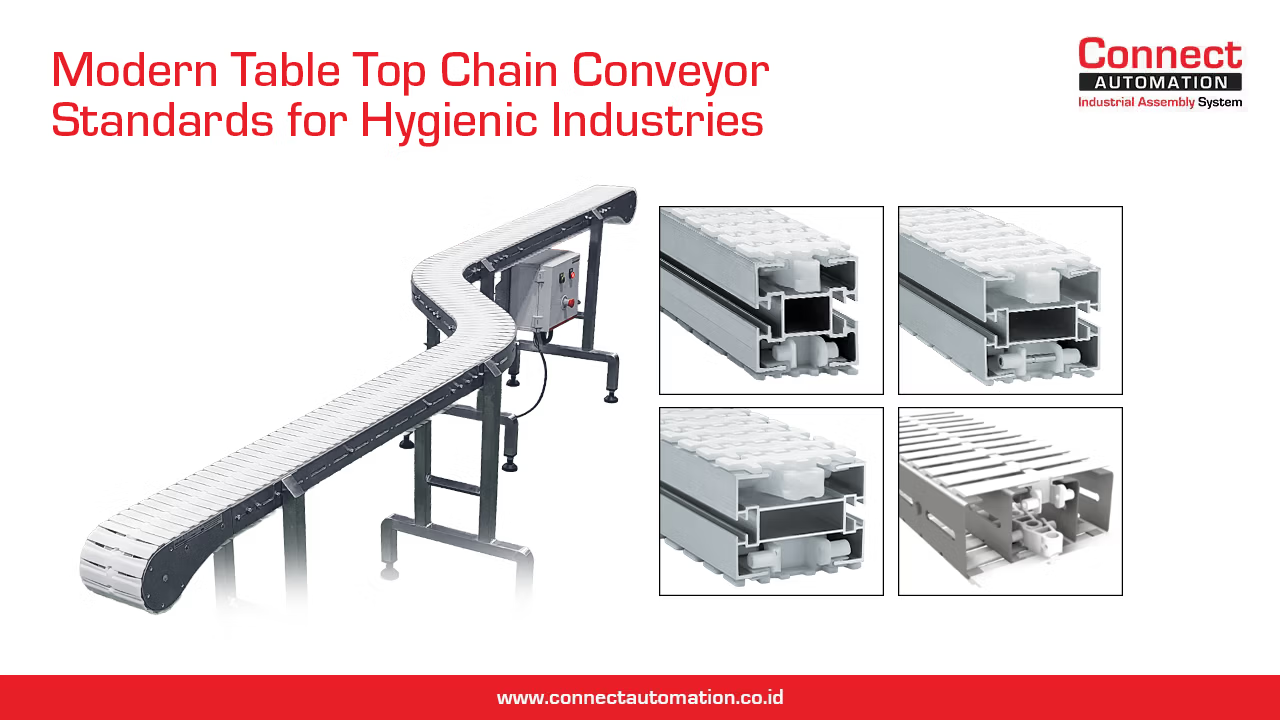
In modern manufacturing, conveyor systems are no longer simply used to transport products from one process to another. As industries continue to demand higher efficiency, hygiene, and automation, conveyors have become a critical component in maintaining product flow stability and supporting overall production performance.
In industries such as food and beverage, pharmaceutical, cosmetics, FMCG, and tobacco manufacturing, selecting the right conveyor system can significantly impact productivity, product quality, and integration with modern production processes.
One of the most widely used solutions is the Table Top Chain Conveyor (TTC), known for its ability to handle various products with stability, flexibility, and efficiency.
Why Conveyor Standards Are Important in Modern Industries
Today's manufacturing environment requires companies to increase production capacity while maintaining consistent product quality. Modern production systems also rely heavily on automation and seamless machine integration.
Under these conditions, conveyors serve not only as transportation systems but also as key components in maintaining production stability throughout the entire process.
For this reason, conveyor design standards play a vital role in ensuring long-term system performance, efficiency, and reliability.
The Development of Table Top Chain Conveyors for Hygienic Industries
Table Top Chain Conveyors have evolved into one of the most commonly used material handling systems for industries with high hygiene requirements.
In addition to providing stable product handling, these systems support increasingly complex production demands, including integration with automated equipment and efficient facility layouts.
This evolution has led to the development of modern conveyor designs that prioritize hygiene, product stability, and flexibility for a wide range of industrial applications.
Hygienic Design for Modern Industries
In food, beverage, pharmaceutical, cosmetic, and FMCG industries, hygiene is a critical requirement. Therefore, conveyor systems must be designed to support fast and effective cleaning procedures. Modern Table Top Chain Conveyor systems incorporate hygienic design principles that help reduce dirt accumulation and simplify cleaning and maintenance activities.
Common hygienic characteristics include:
- Easy-to-clean surfaces
- Designs that support routine cleaning procedures
- Materials suitable for food-grade and pharmaceutical-grade applications
- Structures that simplify inspection and maintenance
- Support for HACCP and GMP implementation
These design principles help minimize contamination risks while maintaining product quality throughout the production process.
Product Stability as a Key Performance Factor
Beyond hygiene, product stability is one of the most important aspects of modern material handling systems.
Products such as beverage bottles, pharmaceutical bottles, vials, lotions, shampoos, and other lightweight packages require conveyor systems capable of maintaining stable positioning throughout the transfer process.
Stable product flow helps reduce the risk of tipping, minimizes interruptions during filling and labeling operations, and supports production consistency at higher operating speeds.
In many industrial applications, product stability is a fundamental factor in maintaining both efficiency and product quality.
More Efficient Conveyor Curves and Turns
Modern production facilities often face space limitations, requiring conveyor systems that can efficiently follow complex production layouts.
One of the advantages of modern Table Top Chain Conveyor systems is their ability to accommodate curves with greater efficiency than many conventional conveyor designs.
This capability helps maximize available production space without compromising product stability. Products can continue moving smoothly and consistently through curved sections, supporting uninterrupted production flow.
The ability to utilize tighter turning radii is one reason why modular conveyor systems are widely adopted in modern manufacturing environments.
Modular Systems That Support Future Automation
As industrial requirements continue to evolve, conveyor systems must be capable of supporting additional equipment and automation technologies.
A modular conveyor design provides greater flexibility for future automation development without requiring complete system replacement.
Key advantages of a modular approach include:
- Easier installation of production sensors
- Support for integration with automated machinery
- Simplified installation of side guides and conveyor accessories
- Support for future automation upgrades
- Easier mounting of control panels and additional devices
This approach allows conveyor systems to grow alongside increasingly sophisticated production requirements.
Modern Modular Conveyor References
In modern manufacturing, several modular conveyor systems have become references for high-precision and hygienic conveyor applications.
Systems such as FlexLink are widely recognized for their ability to maintain product stability, provide consistent flow control, and support complex production layouts through modular design. Similarly, Modu is widely used in industrial applications that require flexibility and efficient use of production space.
The characteristics found in systems such as FlexLink and Modu have become benchmarks for modern conveyor development, particularly in food and beverage, pharmaceutical, cosmetic, FMCG, and other hygienic industries.
These systems demonstrate how conveyor technology continues to evolve to meet increasing demands for stability, precision, and operational efficiency.
Frame Material Standards in Connect Automation Conveyor Systems
To meet the requirements of various industries, Connect Automation conveyor systems are available with frame material options that can be selected according to application needs and production environments.
Frame Materials
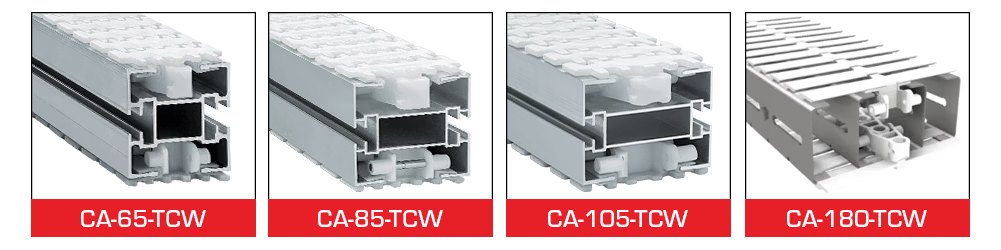
- CA-65-TCW : Aluminum Profile or Stainless Steel 304
- CA-85-TCW : Aluminum Profile or Stainless Steel 304
- CA-105-TCW : Aluminum Profile or Stainless Steel 304
- CA-180-TCW : Stainless Steel 304
These material options allow the conveyor system to be used across a wide range of industries, including food and beverage, pharmaceutical, cosmetic, FMCG, and other production environments that require higher hygienic standards.
Applications Across Various Industries
Table Top Chain Conveyors are widely used across multiple industries due to their ability to maintain product stability and support automated production systems. Common applications include:
- Food and beverage industry
- Pharmaceutical industry
- Cosmetic industry
- FMCG - Fast Moving Consumer Goods industry
- Tobacco / Cigarettes industry
While each industry has unique requirements, the core objectives remain the same: product stability, production efficiency, and seamless integration with automated systems.
Why This Approach Has Become the Modern Standard
Industrial requirements continue to increase in terms of production capacity, product quality, and operational efficiency.
As a result, modern conveyor systems are evaluated not only by their ability to transport products but also by their capability to maintain process stability, support hygienic operations, and integrate with advanced automation technologies.
The combination of modular design, hygienic engineering, and precision handling has become one of the key reasons why modern conveyor systems are increasingly adopted across various industries.
Conclusion
Modern Table Top Chain Conveyors have become an essential part of hygienic production systems. With stable operation, flexible design, and easy cleaning capabilities, these systems support a wide range of industries, including food and beverage, pharmaceutical, cosmetic, FMCG, and tobacco manufacturing.
In practice, Connect Automation develops conveyor systems based on modern modular conveyor principles, where product stability, movement precision, hygienic design, and integration flexibility are the primary focus. Design concepts commonly found in systems such as FlexLink serve as valuable references in delivering optimal conveyor performance for modern industrial applications.
Connect Automation specializes in providing automation solutions, including conveyor systems, to improve efficiency across various industries. The company delivers cutting-edge technology to help organizations automate tasks and optimize workflows. Connect Automation helps businesses reduce manual efforts, boost productivity, and achieve better outcomes. With a customer-focused approach, the company designs tailored solutions to ensure smooth and effective automation transitions for long-term success.
Kawasan Industri Jababeka Tahap 1, Jl. Jababeka II D Blok C14L Cikarang, Indonesia (17530)
(021) 893 5060 Google Maps
Rungkut Industri III, No. 37, Rungkut Menanggal, Kec. Gn. Anyar Surabaya, Indonesia (60293)
(031) 9985 8624 Google Maps