
REQUEST A FREE ESTIMATE!
Belt Conveyor for Plastic Product Transfer to Inspection Packing
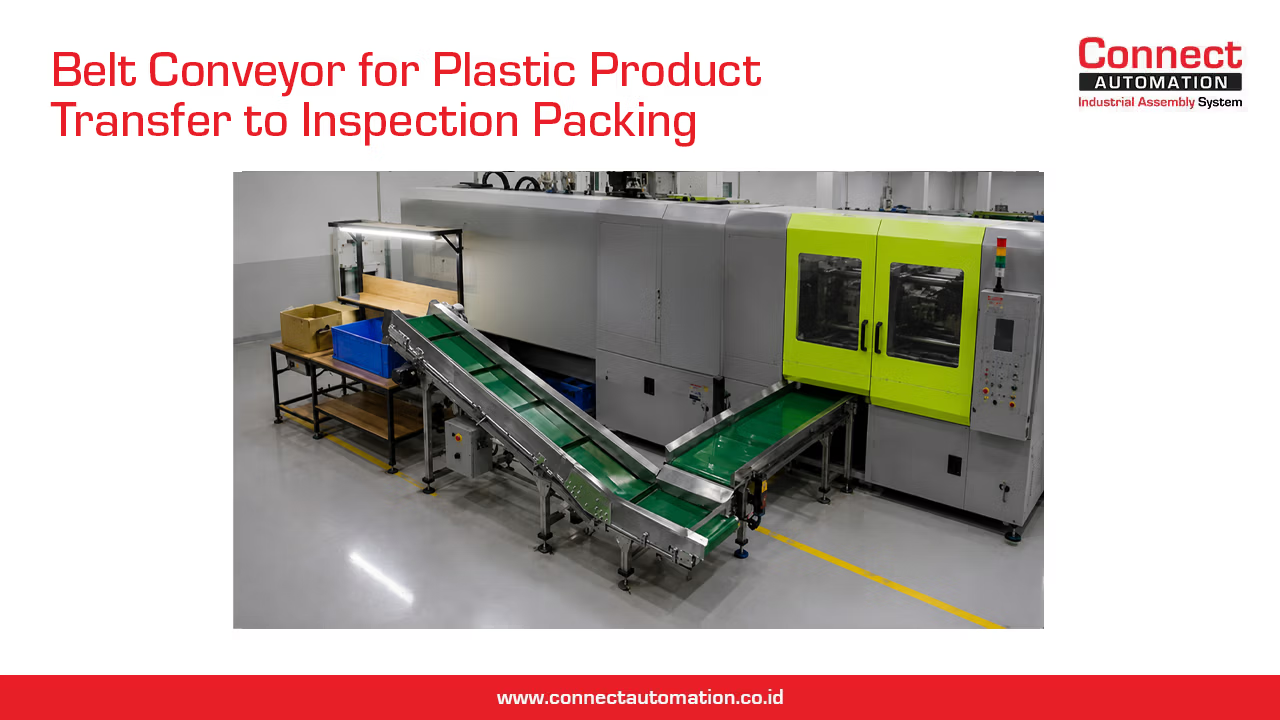
In the plastic manufacturing industry, production does not end when a product exits the machine. Whether it comes from injection molding, blow molding, extrusion, or thermoforming processes, plastic products still need to be efficiently transferred to downstream stages such as inspection, counting, and packaging.
This is where belt conveyors play a critical role as a material handling system that connects production machines with downstream processes in a smooth, stable, and controlled flow.
Challenges in Plastic Product Handling
In most plastic manufacturing facilities, products are produced in high volumes with continuous output. This creates several operational challenges, such as:
- Product accumulation at machine discharge points.
- Inefficient manual handling by operators.
- Risk of product damage during manual transfer.
- Unstable production flow during high output conditions.
- Difficulty maintaining consistent flow toward downstream processes.
Without a proper transfer system, these issues can significantly reduce overall production efficiency.
However, installing a belt conveyor alone may not be enough to solve these challenges. Factors such as conveyor placement, product flow direction, conveyor length, and integration with production machines must be carefully planned to ensure smooth material flow and prevent bottlenecks. To learn why these design considerations are essential for production efficiency, read our article on Why Belt Conveyor Design Layout Matters in Industrial Production.
Role of Belt Conveyors in Plastic Manufacturing
A belt conveyor serves as the main transfer medium between production machines and inspection or packaging areas. It ensures that products move continuously without requiring excessive manual handling.
In plastic manufacturing environments, belt conveyors are commonly used to:
- Transfer products directly from production machines.
- Maintain a stable and continuous product flow.
- Reduce manual handling by operators.
- Connect multiple stages within a production line.
Because of its flexibility, belt conveyors can handle a wide variety of plastic products with different shapes, sizes, and weights.
Applications in Plastic Production Processes
1. Injection Molding Transfer
In injection molding processes, plastic parts are ejected continuously from the machine. A belt conveyor receives these parts and transports them to inspection, sorting, or temporary storage areas. This helps prevent accumulation at the machine and ensures smoother production flow.
2. Blow Molding Transfer
In blow molding processes, products such as bottles, containers, or hollow plastic parts must be transferred immediately after forming. The belt conveyor ensures safe and stable movement to the next process stage.
3. Extrusion and Thermoforming Processes
In extrusion and thermoforming, products are often produced in continuous or semi-continuous form. Belt conveyors help transport these products to cutting, inspection, or packaging areas in a controlled manner.
4. Inspection and Quality Control Area
After leaving the production machine, plastic products typically enter the inspection stage. A belt conveyor allows products to move at a controlled speed, enabling operators to perform:
- Visual inspection
- Basic quality checks
- Simple OK/NG sorting (reject separation)
- Shape or dimensional checks
A stable product flow improves inspection accuracy and operational efficiency.
5. Counting and Packaging Area
After inspection, products are transferred to counting and packaging stages. Belt conveyors ensure a steady and organized flow of products into these areas, helping to:
- Simplify product counting
- Maintain continuous supply to packaging systems
- Reduce manual handling before packaging
- Improve packaging line efficiency
Belt Selection in Plastic Industry Applications
Selecting the right conveyor belt material is an important engineering consideration, as it must match both product characteristics and process requirements.
1. PVC Green Belt for General Plastic Applications
In most standard plastic manufacturing applications such as injection molding, blow molding, extrusion, and thermoforming, PVC green belts are commonly used.
Key characteristics:
- Suitable for non-hygienic plastic products
- Stable surface for lightweight to medium-weight parts
- Cost-effective solution for industrial environments
- Ideal for general production areas
Typical applications:
- Injection molded parts transfer
- Blow molded bottles and containers
- Extruded and thermoformed products
- Transfer to inspection and packaging areas
2. PU White Belt for Hygiene-Related Applications
Although plastic manufacturing is generally not a hygienic industry, some applications overlap with sectors that require higher cleanliness standards, such as:
- Pharmaceutical packaging
- Medical-related plastic components
- Cosmetic packaging
- Tube or container production for sensitive applications
In these cases, PU white belts (food-grade belts) are preferred due to:
- Easier cleaning and maintenance
- Compliance with higher hygiene standards
- Suitability for regulated or sensitive applications
- Safer use in controlled environments
Important Note: Industry Boundary Considerations
Plastic manufacturing sits between general industrial production and hygiene-sensitive industries. Therefore, belt selection is not only based on the plastic industry itself, but also on the end-use application of the product.
For example:
- General industrial plastic parts → PVC belt is sufficient
- Food/pharmaceutical-related packaging → PU food-grade belt is required
- Sensitive applications → higher hygiene standards must be considered
Integration with Simple Automation Systems
In many plastic production lines, belt conveyors are integrated with simple automation systems such as:
- Vision inspection systems for surface checking
- Product counting systems
- Reject handling systems
- Packaging systems
This allows manufacturers to improve efficiency without requiring complex robotic automation.
Benefits of Belt Conveyors in Plastic Manufacturing
- Reducing Manual Handling : Products are transferred automatically between processes, reducing operator workload.
- Improving Production Stability : A continuous product flow helps maintain stable machine output.
- Supporting Inspection Processes : Controlled movement improves accuracy in quality control operations.
- Reducing Product Damage : Automated handling minimizes the risk of product damage during transfer.
- Increasing Production Line Efficiency : A well-designed conveyor system improves overall productivity and process flow.
Conclusion
Belt conveyors play an essential role in plastic manufacturing by connecting production machines with inspection and packaging areas. Whether used in injection molding, blow molding, or other plastic processing methods, they help ensure a stable, efficient, and controlled material flow.
By reducing manual handling, supporting inspection processes, and improving packaging efficiency, belt conveyors significantly contribute to modern plastic production systems. The correct selection of belt material—such as PVC green belts for general applications and PU white belts for hygiene-related applications—ensures the system is properly aligned with both production needs and end-use requirements.
Connect Automation specializes in providing automation solutions, including conveyor systems, to improve efficiency across various industries. The company delivers cutting-edge technology to help organizations automate tasks and optimize workflows. Connect Automation helps businesses reduce manual efforts, boost productivity, and achieve better outcomes. With a customer-focused approach, the company designs tailored solutions to ensure smooth and effective automation transitions for long-term success.
Kawasan Industri Jababeka Tahap 1, Jl. Jababeka II D Blok C14L Cikarang, Indonesia (17530)
(021) 893 5060 Google Maps
Rungkut Industri III, No. 37, Rungkut Menanggal, Kec. Gn. Anyar Surabaya, Indonesia (60293)
(031) 9985 8624 Google Maps