
REQUEST A FREE ESTIMATE!
Belt Conveyors for Primary Packaging to Carton Handling
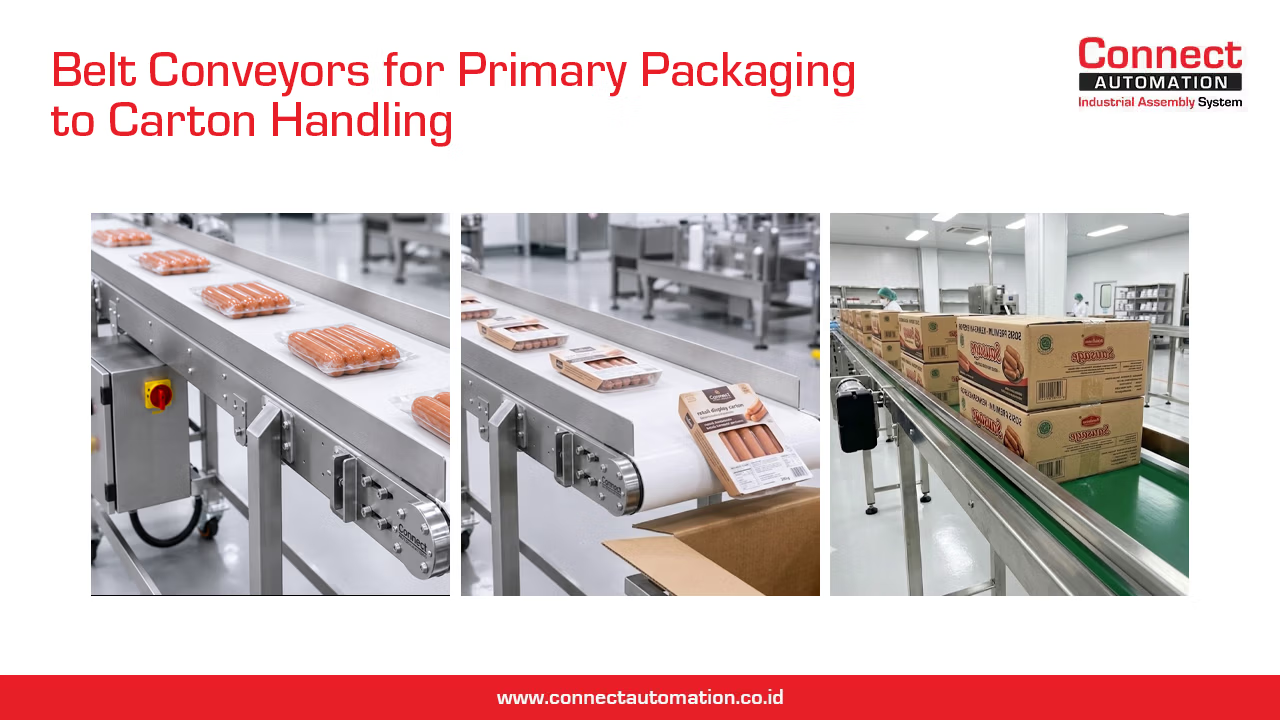
In many manufacturing processes, product movement does not stop once production is completed. After products are packaged, they still go through several downstream stages such as inspection, grouping, secondary packaging, cartoning, and distribution preparation. This is where belt conveyors play an important role in maintaining a smooth and efficient product flow.
These applications can be found across various industries, including food and beverage, pharmaceutical, cosmetics, electronics, plastics, consumer goods, as well as logistics and distribution.
Why Are Belt Conveyors Widely Used in Packaging Areas?
Packaged products generally have a more stable form and better protection compared to products that are still in the manufacturing stage. This makes belt conveyors an effective solution for handling products throughout different packaging processes.
Some of the reasons why belt conveyors are commonly used in packaging areas include:
- Able to handle a wide range of package shapes and sizes
- Support consistent product flow
- Easy integration with packaging equipment
- Help reduce manual handling
- Flexible for various production layouts
Handling Primary Packaging
Primary packaging refers to the packaging that directly contains the product and represents the smallest unit received by the end user or consumer. Examples include:
- Pouches
- Sachets
- Bottles
- Jars
- Tubes
- Blister packs
- Individual product boxes
- Electronic products in individual packaging
- Plastic products packaged for distribution
In industries such as food and beverage, pharmaceutical, and cosmetics, primary packaging areas are often located close to production processes, where hygiene requirements remain an important consideration.
For this reason, many applications in this area utilize PU white belt conveyors combined with stainless steel frames. This combination helps support cleanliness, ease of cleaning, and durability in more demanding production environments.
At this stage, belt conveyors are commonly used to transfer products to inspection, labeling, coding, grouping, or subsequent packaging processes.
Supporting Secondary Packaging
After products have been placed in primary packaging, the process often continues to secondary packaging, where multiple products are grouped into a larger unit for easier storage and distribution. Examples of secondary packaging applications include:
- Multipacks
- Bundling
- Shrink wrapping
- Tray packs
- Inner box packaging
This stage is commonly found in food and beverage, pharmaceutical, cosmetics, electronics, plastics, and consumer goods industries.
Since the products are already protected by their primary packaging, hygiene requirements are generally less demanding than in the previous stage. As a result, conveyors can utilize either PU white belts or PVC green belts, depending on the application requirements and production environment.
For conveyor construction, both aluminum profile frames and stainless steel frames are widely used because they offer design flexibility and easy integration with equipment such as labeling machines, shrink wrappers, cartoners, and bundling machines.
Belt conveyors help maintain a continuous product flow, allowing packaging operations to run more efficiently.
Carton and Box Handling
Once the packaging process is completed, products are typically packed into cartons or boxes to facilitate storage, shipping, and distribution.
At this stage, the products are fully protected by both their packaging and cartons, shifting the conveyor's primary focus toward efficient material handling.
For this reason, PVC green belt conveyors are among the most commonly used solutions for carton and box handling applications. Typical applications include:
- Carton transfer between processes
- Feeding products to sealing machines
- Feeding products to labeling machines
- Transfer to palletizing areas
- Transfer to palletizing areas
In the electronics and plastics industries, conveyors are frequently used to move cartons containing finished products to final packing or storage areas. In logistics and distribution centers, conveyors help accelerate box movement between operational zones before shipment.
The use of conveyors helps reduce manual handling while improving operational efficiency at the end of the production line. Find more comprehensive information about the packaging industry in the article Conveyor Systems for Packaging Industry Production Lines.
Why Is PVC Green Belt Commonly Used?
For secondary packaging and carton handling applications, PVC green belts are one of the most widely used conveyor belt types.
Some of their advantages include:
- Suitable for packaged products
- Stable transportation of cartons and boxes
- Cost-effective for long-term operation
- Easy maintenance and replacement
- Widely used across multiple industries
Since the products no longer come into direct contact with the belt, conveyor selection at this stage is generally focused on operational efficiency, durability, and ease of maintenance.
Special Requirements in the Electronics Industry
Although packaging and carton handling principles in the electronics industry are similar to those in other sectors, certain applications require additional considerations.
To help reduce the risk of damage caused by static electricity, many electronics manufacturing facilities use ESD belts (Electrostatic Discharge Belts) or anti-static belts. These belt types are designed to help control static charge accumulation that could affect sensitive electronic components during production, assembly, or handling processes.
To help reduce the risk of damage caused by static electricity, many electronics manufacturing facilities use ESD belts (Electrostatic Discharge Belts) or anti-static belts. These belt types are designed to help control static charge accumulation that could affect sensitive electronic components during production, assembly, or handling processes.
The selection of belt material should always be based on product characteristics and the manufacturing standards implemented within each facility.
In many electronics manufacturing facilities, belt conveyors are integrated with industrial workstations to support assembly, inspection, and quality control processes more efficiently. Combining conveyors with workstations creates a well-organized production flow, reduces unnecessary manual material handling, and improves operator productivity throughout each stage of the manufacturing process. To learn more about how workstations contribute to an integrated production system, read our article on Industrial Workstations as Part of Integrated Production System.
When Is a Roller Conveyor a Better Choice?
Although belt conveyors are highly effective for handling packaged products and cartons, there are situations where roller conveyors may be a more suitable solution.
Roller conveyors are commonly used for:
- Large cartons
- Master cartons
- Warehouse operations
- Distribution areas
- Pallet handling systems
In these applications, roller conveyors can provide additional efficiency, particularly when handling heavier loads and supporting internal logistics processes.
Used Across Various Industries
Because of their flexibility, belt conveyors for packaging and carton handling are widely used in many industries, including:
- Food and beverage
- Pharmaceutical
- Cosmetics and personal care
- Electronics
- Plastics and packaging
- Consumer goods
- Logistics and distribution
Although products vary significantly between industries, the need to move packaged products safely and efficiently remains a critical part of modern manufacturing operations.
Conclusion
Belt conveyors provide an effective solution for handling products from primary packaging and secondary packaging through to carton handling and distribution preparation. The choice of belt type and conveyor frame material can be tailored according to the product's position within the production process and the specific requirements of the operating environment.
PU white belts with stainless steel frames are commonly used in primary packaging areas where higher hygiene standards are required. For secondary packaging applications, both PU white belts and PVC green belts can be used depending on operational needs. Meanwhile, PVC green belts are widely used for carton and box handling because they provide stable, efficient, and cost-effective product transportation across various industries.
For specialized applications such as electronics manufacturing, ESD belts may also be considered to help protect sensitive components from the risks associated with static electricity during production and product handling.
Connect Automation specializes in providing automation solutions, including conveyor systems, to improve efficiency across various industries. The company delivers cutting-edge technology to help organizations automate tasks and optimize workflows. Connect Automation helps businesses reduce manual efforts, boost productivity, and achieve better outcomes. With a customer-focused approach, the company designs tailored solutions to ensure smooth and effective automation transitions for long-term success.
Kawasan Industri Jababeka Tahap 1, Jl. Jababeka II D Blok C14L Cikarang, Indonesia (17530)
(021) 893 5060 Google Maps
Rungkut Industri III, No. 37, Rungkut Menanggal, Kec. Gn. Anyar Surabaya, Indonesia (60293)
(031) 9985 8624 Google Maps