REQUEST A FREE ESTIMATE!
Incline Belt Conveyor Solutions for Level Product Transfer
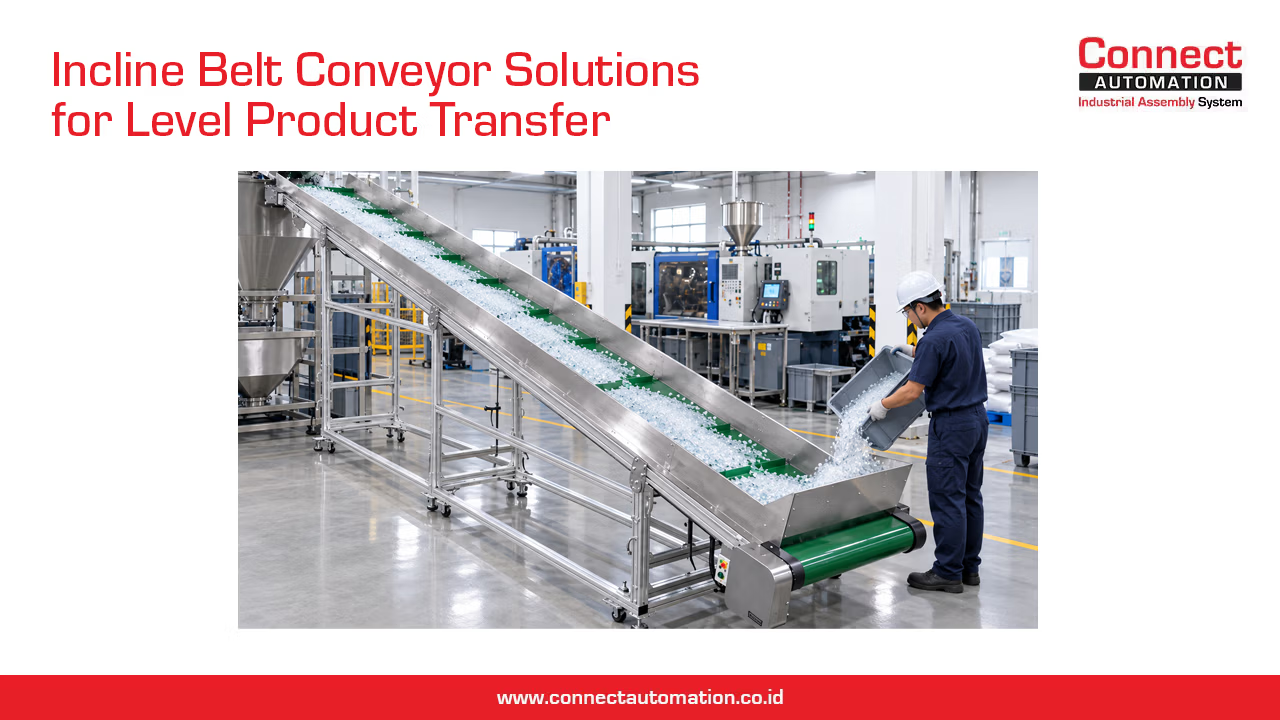
In a production line, not every process is located at the same height. In some applications, products or materials need to be transferred from a lower area to a higher level, either to move between production levels or to reach the next stage of the process.
An Incline Belt Conveyor can provide an efficient solution for this type of application. With an inclined conveying path, products can be continuously transported to the required elevation without requiring manual handling between different levels.
Its application can also go beyond simple product transfer. An incline conveyor can be used as an autoloader or feeding conveyor to move materials into a hopper before they enter the next process, such as cooking, mixing, packaging, filling, or other production processes.
What Is the Purpose of an Incline Belt Conveyor?
In general, an Incline Belt Conveyor is used when products or materials need to be transported to a higher position. However, its application can serve several different production needs.
1. Transferring Products Between Different Levels
One common application is connecting production areas located at different elevations.
For example, products from a production area on the first floor can be transferred using an incline conveyor to a process area on the second floor. The conveyor acts as a continuous link between the two levels, allowing products to move smoothly from one production area to another.
This configuration can be useful when a production facility has different elevations or when the next process is located on a raised platform.
2. Autoloader for Feeding a Hopper
An Incline Belt Conveyor can also be used as an autoloader to transport materials into a hopper.
In this application, the conveyor does more than simply transfer material. It becomes part of the feeding system that supplies material to the next production process.
For example:
Material → Incline Conveyor → Hopper → Next Process
Once the material enters the hopper, it can continue to processes such as:
- Cooking
- Mixing
- Packaging
- Filling
- Other production processes
This configuration helps connect processes with different elevations while maintaining a continuous flow of material to the next stage.
Examples of Incline Belt Conveyor Applications
Incline Belt Conveyors can be used for various product and material transfer requirements, depending on the production layout and process.
1. Transfer Between Production Areas
When two production areas are located at different heights, an incline conveyor can be used to connect them and move products from one area to another.
2. Feeding a Hopper
Materials can be elevated into a hopper positioned at a higher level. From there, the material can continue to the next production process.
3. Transfer to a Packaging Line
Products can be elevated to match the required height of a packaging machine or the next conveyor in the production line.
4. Feeding a Production Process
Materials can be elevated to processes such as cooking, mixing, filling, or other operations that require materials to be delivered at a specific elevation.
Therefore, an incline conveyor should be designed based on the material flow and production requirements, rather than simply being treated as a conveyor with an angled belt.
How Does an Incline Belt Conveyor Move Products?
The basic operating principle of an incline conveyor is similar to a standard belt conveyor. The belt moves continuously and carries products from the loading point toward the destination.
The main difference is that the belt is positioned at an angle to achieve the required elevation.
Because products are being transported upward, several factors need to be considered to ensure stable movement. Product type, weight, shape, surface characteristics, belt type, and incline angle can all influence the conveyor design.
For this reason, an incline conveyor should be designed according to the characteristics of the product and the requirements of the production process.
How Can Products Be Kept Stable on an Incline Conveyor?
One important consideration when designing an incline conveyor is keeping products in the correct position while they are being transported upward. Several design elements can be used depending on the application.
1. Belt Surface
Belt selection is an important consideration. For certain applications, a belt surface with better grip can help products remain stable as they move along the incline.
2. Cleats
Cleats are raised elements installed across the belt surface to help support products while they are being transported upward.
They can help products move more consistently with the belt, particularly in applications with a specific incline angle.
3. Side Walls
Side walls can be added along the sides of the belt to help keep products within the conveying area.
The need for side walls depends on the product characteristics, product dimensions, and overall conveyor design.
These elements do not necessarily need to be used together. Their configuration should be determined based on the product and application requirements.
How to Determine the Incline Conveyor Angle
The incline angle is an important part of conveyor design. The appropriate angle depends on the product characteristics and the overall conveyor configuration. Several factors should be considered, including:
- Product or material type
- Product weight
- Product shape and dimensions
- Product surface characteristics
- Belt type
- Cleat configuration
- Side wall requirements
- Required elevation
- Available conveyor length
For example, a product with a smooth surface may require a different configuration from a material with a rougher surface. Similarly, boxed products may have different requirements from production materials with irregular shapes.
Therefore, the incline angle should be determined based on the overall application requirements, rather than only the difference in elevation.
Incline Belt Conveyor Speed
In addition to the incline angle, belt speed should be matched to the requirements of the production line. An incline conveyor may be connected directly to another process or machine. Its speed should therefore consider the required transfer capacity and the product flow before and after the conveyor.
For example, when the conveyor is used to feed a hopper, its speed and conveying capacity should be matched to the requirements of the process receiving the material. The same principle applies when an incline conveyor is connected to a packaging machine, filling machine, or another conveyor.
Integrating an Incline Belt Conveyor into a Production Line
An Incline Belt Conveyor can be designed as part of a larger production system.
Some example configurations include:
Conveyor → Incline Conveyor → Hopper
Conveyor → Incline Conveyor → Packaging Machine
Production Process → Incline Conveyor → Next Process
For these applications, the conveyor design should consider the inlet and outlet positions, machine elevations, conveying capacity, conveyor speed, and available space within the production area.
When required, the conveyor system can also be equipped with sensors and control systems to coordinate product flow with the next process.
Factors to Consider Before Building an Incline Conveyor
Before determining the design of an Incline Belt Conveyor, several basic requirements should be established:
- Product or material to be conveyed
- Product weight and dimensions
- Starting and destination elevations
- Required conveying capacity
- Available conveyor length
- Suitable incline angle
- Belt type
- Cleat requirements
- Side wall requirements
- Conveyor speed
- Process or machine connected to the conveyor
These details help determine a conveyor configuration that fits the requirements of the production line.
Incline Belt Conveyor for Production Applications
An Incline Belt Conveyor can serve a variety of production needs, from transferring products between different levels to feeding materials into a hopper and delivering them to the next production process.
Its design can be customized according to the product characteristics, conveying capacity, required elevation, facility layout, and connected production processes.
With the right configuration, an incline conveyor can become an important part of maintaining a continuous material flow from one production stage to the next.
For Incline Belt Conveyor solutions designed around your production layout and process requirements, the conveyor configuration can be determined based on the product being conveyed, required capacity, elevation, and production line integration.
Connect Automation specializes in providing automation solutions, including conveyor systems, to improve efficiency across various industries. The company delivers cutting-edge technology to help organizations automate tasks and optimize workflows. Connect Automation helps businesses reduce manual efforts, boost productivity, and achieve better outcomes. With a customer-focused approach, the company designs tailored solutions to ensure smooth and effective automation transitions for long-term success.
Kawasan Industri Jababeka Tahap 1, Jl. Jababeka II D Blok C14L Cikarang, Indonesia (17530)
(021) 893 5060 Google Maps
Rungkut Industri III, No. 37, Rungkut Menanggal, Kec. Gn. Anyar Surabaya, Indonesia (60293)
(031) 9985 8624 Google Maps