REQUEST A FREE ESTIMATE!
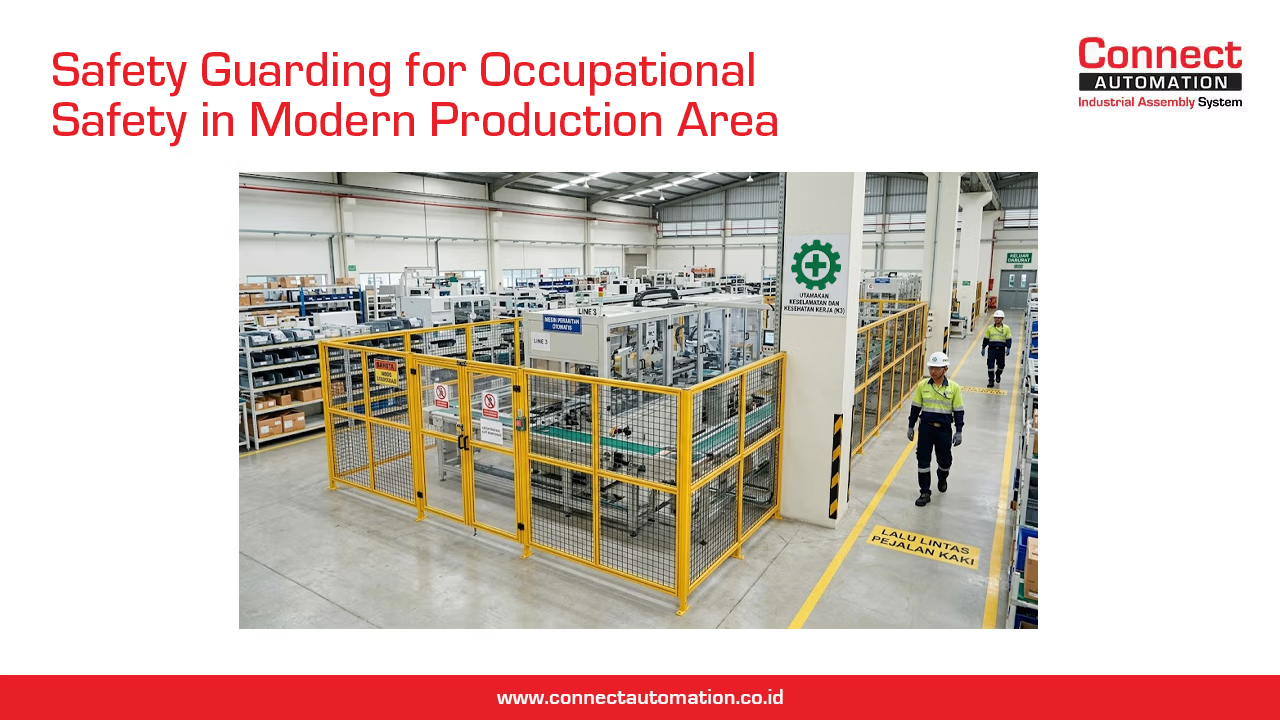
Safety Guarding for Occupational Safety in Modern Production Area
Occupational Safety (K3) Is More Than Just a Formal Requirement
In many industrial environments, Occupational Safety and Health (K3) is still seen as a formality—something implemented mainly to meet audit requirements or documentation standards. In reality, K3 plays a far more critical role, especially in production areas where machines, material flow, and human interaction are closely connected.
In high-activity production environments, the risk of workplace accidents is always present. Therefore, K3 should be viewed as an operational necessity, not merely a regulatory obligation.
Understanding K3 in an Industrial Context
K3 (Occupational Safety and Health) aims to:
- Protect workers from potential hazards
- Prevent workplace accidents
- Create a safe and controlled working environment
In Indonesia, K3 implementation is regulated by Kementerian Ketenagakerjaan Republik Indonesia, including Law No. 1 of 1970 on Occupational Safety and the Occupational Safety Management System (SMK3). In Indonesia, K3 implementation is regulated by Kementerian Ketenagakerjaan Republik Indonesia, including Law No. 1 of 1970 on Occupational Safety and the Occupational Safety Management System (SMK3).
However, the effectiveness of K3 depends not only on regulations, but on how safety systems are implemented in real operational conditions.
Challenges in Implementing K3 in Production Areas
Implementing K3 in production environments comes with several challenges, such as:
- High interaction between humans and machines
- Dense and continuous production flow
- Limited workspace
- High production targets and operational pressure
In such conditions, relying solely on SOPs and operator awareness is not sufficient. A system that provides consistent and reliable protection is required.
The Role of Safety Guarding in Supporting K3
Safety guarding is a critical component in the implementation of K3 in production areas. It is not merely an additional feature, but part of the core protection system.
- Preventing Access to Hazardous Areas : Safety guarding acts as a physical barrier that prevents operators from entering dangerous machine zones, such as rotating, moving, or pinch point areas.
- Reducing Dependence on Human Factors : While training and SOPs are essential, human error cannot be eliminated. Safety guarding provides an additional layer of protection that functions independently of operator behavior.
- Supporting Work Area Standardization : Clear physical boundaries help define safe and restricted zones, making the work environment more structured and easier to manage.
- Enabling Preventive Safety Measures : Safety guarding supports a preventive approach by reducing the likelihood of accidents before they occur, rather than reacting afterward.
Integration of Safety Guarding in Modern K3 Systems
In modern industrial systems, safety guarding is rarely used as a standalone solution. It is often integrated with technologies such as:
- Sensors to detect specific conditions
- Interlock systems that automatically stop machines when guards are opened
This integration ensures that machines operate only under safe conditions, significantly enhancing the effectiveness of K3 implementation.
Implementing Safety Guarding in Production Areas
Safety guarding is commonly applied in various production areas, including:
- Conveyor systems
- Automated and semi-automated machines
- Robot cells
- Loading and unloading zones
In environments with high activity and limited space, safety guarding helps establish clear safety boundaries between operators and machines without disrupting workflow. Find more detailed information in the article Safety Guarding Applications in Modern Industrial Systems.
Risks of Poor K3 Implementation
Failure to properly implement K3 can lead to serious consequences, including:
- Workplace accidents affecting personnel
- Production downtime due to incidents
- Significant financial losses
- Potential regulatory penalties
- Damage to company reputation
These risks highlight that K3 is not only about safety, but also directly related to business continuity.
Safety Guarding as Part of a Comprehensive K3 System
It is important to understand that safety guarding is not a standalone solution. It is part of a broader K3 system that includes:
- Standard operating procedures (SOPs)
- Operator training
- Machine control systems
- Periodic risk assessments
With a well-integrated approach, safety guarding can function optimally in supporting workplace safety.
Conclusion
Occupational Safety and Health (K3) is an essential aspect of industrial operations that cannot be overlooked. In increasingly complex production environments, safety guarding plays a key role in supporting effective safety system implementation.
By combining proper physical protection with modern control systems, companies can not only enhance workplace safety but also ensure stable and sustainable operations.
Connect Automation specializes in providing automation solutions, including conveyor systems, to improve efficiency across various industries. The company delivers cutting-edge technology to help organizations automate tasks and optimize workflows. Connect Automation helps businesses reduce manual efforts, boost productivity, and achieve better outcomes. With a customer-focused approach, the company designs tailored solutions to ensure smooth and effective automation transitions for long-term success.
Kawasan Industri Jababeka Tahap 1, Jl. Jababeka II D Blok C14L Cikarang, Indonesia (17530)
(021) 893 5060 Google Maps
Rungkut Industri III, No. 37, Rungkut Menanggal, Kec. Gn. Anyar Surabaya, Indonesia (60293)
(031) 9985 8624 Google Maps