REQUEST A FREE ESTIMATE!
Modular Conveyors for Household Products & Packaging Lines
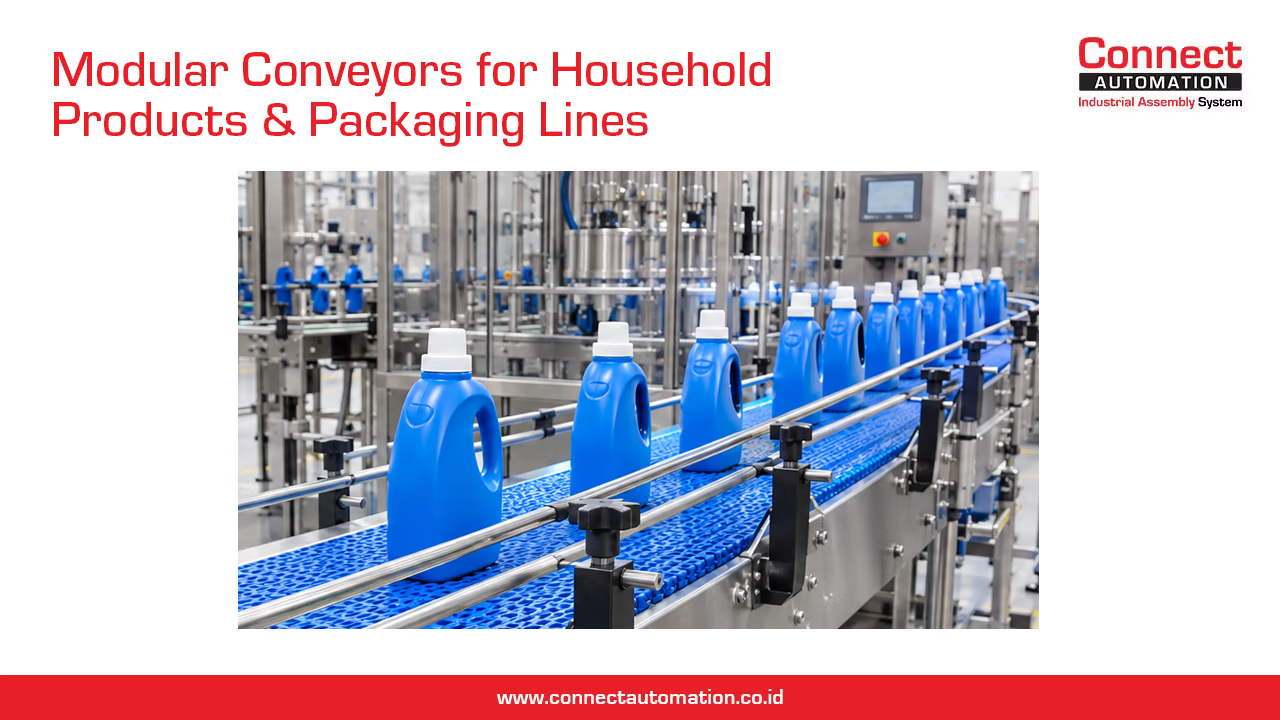
The household consumer products industry involves a dynamic production process. Products such as liquid detergent, fabric softener, dishwashing liquid, floor cleaner, glass cleaner, and disinfectants are commonly produced in large quantities and packaged in bottles, pouches, or various types of containers.
Throughout this process, products need to move efficiently from one production stage to another. After filling process, for example, bottles may need to move to capping, labeling, inspection, and packaging processes in a continuous production line.
A modular conveyor can be used to support these product transfer processes. With a modular belt and a configurable conveyor design, the system can be adapted to the product, production capacity, and available production layout.
What Are Household Products?
In this context, household products refer to consumer products used for everyday household needs, particularly laundry, dishwashing, and household cleaning products. Examples include:
- Liquid detergent
- Fabric softener
- Dishwashing liquid
- Floor cleaner
- Glass cleaner
- Disinfectants
- Multi-purpose cleaners
Many of these products are liquid-based and packaged in bottles or containers with different shapes and sizes. These variations in packaging make it important to design the conveyor according to the product characteristics and requirements of the production line.
Where Is a Modular Conveyor Used in the Production Line?
In household product manufacturing, modular conveyors are commonly used to transfer packaged products from one production stage to another.
A typical production flow may look like this:
Product Preparation → Filling → Capping → Labeling → Inspection → Packaging
Modular conveyors can be positioned between several of these processes.
For example:
Filling → Modular Conveyor → Capping
Capping → Modular Conveyor → Labeling
Labeling → Modular Conveyor → Inspection
Inspection → Modular Conveyor → Packaging
With this configuration, products can move continuously between processes while remaining integrated with the machines throughout the production line.
Applications of Modular Conveyors for Household Products
1. Transferring Products After Filling
Once the filling process is complete, bottles or containers need to move to the next stage. A modular conveyor can connect the filling machine with the capping machine.
At this stage, factors such as bottle dimensions, filled product weight, conveyor speed, and product spacing should be considered to maintain stable product movement.
2. Moving Products to the Capping Process
Liquid household products generally go through a capping process after filling. A modular conveyor can maintain product flow between the filling and capping machines.
Side guides can also be incorporated based on the shape and dimensions of the packaging to help keep products properly positioned while moving along the conveyor.
3. Moving Products to Labeling
After capping, products can continue to the labeling machine. The conveyor helps maintain product flow and provides the required spacing for consistent labeling.
For higher production capacities, conveyor speed, product spacing, and the number of products moving simultaneously become important considerations when designing the system.
4. Inspection and Quality Control
A modular conveyor can also be part of an inspection area. Products that have been labeled can pass through an inspection station before continuing to the packaging process.
The conveyor can be configured to accommodate operators, sensors, vision inspection systems, or other equipment integrated into the production line.
5. Moving Products to Packaging
After inspection, products can continue to secondary packaging processes, such as product grouping, carton packing, or other packaging operations.
A modular conveyor helps connect these stages so products can move in an organized flow from one process to another.
Do Small Products Need a Wide Conveyor?
The width of a conveyor is determined by the requirements of the production line, rather than simply by the size of an individual product. For example, a small bottle can be transported in multiple lanes at the same time. In this configuration, the conveyor width can be determined based on the number of products that need to be transferred simultaneously.
Several factors should be considered, including:
- Product dimensions
- Product weight
- Number of lanes
- Production capacity
- Conveyor speed
- Product spacing
- Production layout
- Machine configuration
This means modular conveyors can be designed for different packaging sizes as long as the conveyor dimensions and configuration are matched to the production requirements.
Considering Spills and Product Residue
During liquid product manufacturing, small spills or product residue may occur around filling and transfer areas.
This condition can be considered during conveyor design. Belt and conveyor component materials can be selected based on the product characteristics, production environment, and cleaning methods used in the facility.
The conveyor design can also provide appropriate access for inspection and cleaning, making it easier to maintain the belt and surrounding components during regular operation.
Modular Conveyors for Cleaning Requirements
Household product manufacturing requires a well-maintained production environment, especially when liquid products can leave residue around the production area or conveyor.
A modular conveyor can be designed to support regular cleaning according to the requirements of the production environment.
Routine cleaning helps remove product residue, liquid residue, dust, and other materials that may accumulate during production.
Cleaning requirements should also be considered when selecting the belt, frame, and conveyor components. For production environments requiring more frequent or intensive cleaning, suitable frame and component materials can help support maintenance and cleaning activities.
Selecting the Right Modular Conveyor Materials
Conveyor materials should be selected according to the product characteristics and production environment. Factors that may be considered include:
- Type of product being conveyed
- Characteristics of liquids or substances that may come into contact with the conveyor
- Process temperature
- Cleaning frequency
- Production environment
- Maintenance requirements
Belt and component materials should be selected based on the actual conditions of the production line. Different household products may have different formulations, which can influence the material requirements of the conveyor. For the frame, stainless steel can be considered for production environments that require regular cleaning and a more controlled level of cleanliness.
Integrating the Conveyor with Production Machines
A modular conveyor in a household product production line generally works as part of an integrated system. Its design therefore needs to correspond with the machines connected to it.
A simple configuration could look like this:
Filling Machine → Modular Conveyor → Capping Machine → Modular Conveyor → Labeling Machine → Inspection → Modular Conveyor → Packaging
Several factors should be considered during integration, including:
- Machine inlet and outlet heights
- Speed of each process
- Product spacing
- Production capacity
- Sensor positions
- Conveyor width
- Number of lanes
- Side guides
- Production layout
With proper planning, the modular conveyor can be designed around the requirements of the production line and the available space.
Examples of Household Products Using Modular Conveyors
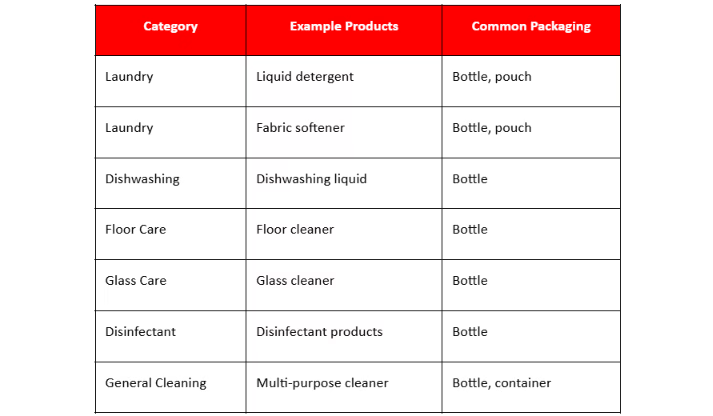
The modular conveyor configuration can be adapted to each product based on packaging dimensions, product weight, production capacity, and cleaning requirements.
What to Prepare Before Designing a Modular Conveyor
Before determining the conveyor specifications, several production-line details should be prepared:
- Product type : Identify the household product that will be conveyed.
- Packaging type and dimensions : Bottle, pouch, or container dimensions will influence the conveyor configuration.
- Product weight : The filled product weight should be considered when determining the conveyor requirements.
- Production capacity : Products per minute or hour provide a basis for determining conveyor speed and line configuration.
- Number of lanes : Determine how many products need to move simultaneously.
- Product spacing : The spacing between products should match the requirements of the next production process.
- Product characteristics : Consider the possibility of spills, residue, or liquids coming into contact with the conveyor.
- Cleaning requirements : Cleaning methods and frequency should be considered during the design process.
- Production layout : The position of each machine and working area will influence the conveyor length, direction, and configuration.
- Machine integration : Information about filling, capping, labeling, inspection, and packaging equipment helps determine the overall conveyor design.
Modular Conveyors for Household Product Production Lines
Modular conveyors can play an important role in household product production lines, particularly for transferring bottles, pouches, and containers between production stages.
Products such as liquid detergent, fabric softener, dishwashing liquid, floor cleaner, and other household cleaning products have different characteristics, so the conveyor should be designed around the requirements of each production line.
Product dimensions and weight, number of lanes, production capacity, product spacing, spill considerations, and cleaning requirements can all be used as the basis for determining the right modular conveyor configuration.
With the right design, a modular conveyor can help create an organized product flow from filling through packaging while supporting the integration of different machines within the production line.
Connect Automation specializes in providing automation solutions, including conveyor systems, to improve efficiency across various industries. The company delivers cutting-edge technology to help organizations automate tasks and optimize workflows. Connect Automation helps businesses reduce manual efforts, boost productivity, and achieve better outcomes. With a customer-focused approach, the company designs tailored solutions to ensure smooth and effective automation transitions for long-term success.
Kawasan Industri Jababeka Tahap 1, Jl. Jababeka II D Blok C14L Cikarang, Indonesia (17530)
(021) 893 5060 Google Maps
Rungkut Industri III, No. 37, Rungkut Menanggal, Kec. Gn. Anyar Surabaya, Indonesia (60293)
(031) 9985 8624 Google Maps