REQUEST A FREE ESTIMATE!
Non Powered Production Flow Systems Stability Before Automation
In many discussions about productivity improvement, automation often becomes the main focus. New machines, robots, and automated systems promise higher output and efficiency. However, in real-world operations, many companies face the same outcome: high investment costs, unstable performance, and increased operational complexity.
This highlights a fundamental principle that is often overlooked: automation should reinforce a stable system, not replace one that does not yet exist.
Production Stability Does Not Always Start with Machines
For business owners, production stability is not just about speed or volume. It means:
- Consistent output
- Reliable product quality
- Predictable operating costs
- Reduced operational risk
The challenge is that instability is frequently addressed by adding machines or automation. When material flow, human interaction, and work sequence are not well structured, automation simply accelerates existing inefficiencies instead of solving them.
What Are Non-Powered Production Flow Systems?
Non-powered production flow systems do not reject technology or represent a step backward. Instead, they focus on:
- Clear and controlled material flow
- Efficient and safe human interaction
- Simple, repeatable work motions
- Mechanical solutions without motors or electrical drives
The objective is not to replace people, but to support human work through simplicity, consistency, and stability.
Why This Approach Matters for Business Owners
From an owner’s perspective, non-powered systems offer several strategic advantages.
1. Lower Investment Risk
Without complex powered equipment:
- initial investment remains controlled
- downtime risk due to machine failure is minimized
- maintenance requirements are simpler
This is especially valuable when production processes are still evolving or not yet fully stabilized.
2. Stability Comes from the System, Not Technology
A well-designed flow system ensures that:
- materials move in a clear and predictable sequence
- work processes are repeatable and consistent
- unnecessary variation is reduced
Once the system is stable, automation becomes an accelerator, not a corrective measure.
3. Improved Safety and Work Quality
Non-powered systems allow layouts that:
- minimize body rotation and excessive reaching
- reduce the risk of minor injuries and fatigue
- maintain a comfortable and sustainable work rhythm
Safer operations directly contribute to consistent quality and long-term operational continuity.
From System Thinking to Practical Solutions
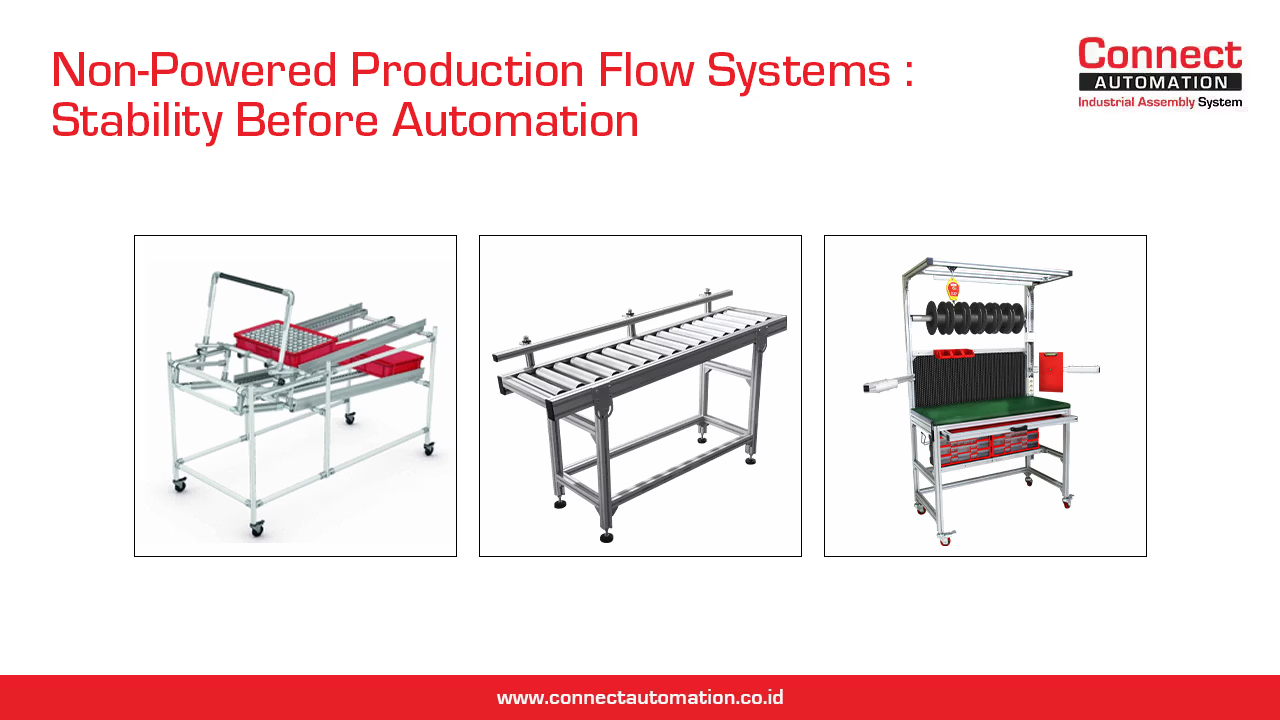
To translate this approach into reality, non-powered production flow systems are commonly implemented through simple mechanical solutions such as:
- Karakuri mechanisms using gravity or spring-based movement
- Standing workstations that keep tools and materials within optimal reach
- Trolleys and flow racks that support one-directional material flow
- Gravity conveyors that move products without motors
Here, products serve as expressions of the system, not the starting point.
The Role of Structure and Materials
Structural design plays an important role in non-powered systems. Various materials can be used, including:
- square profiles
- stainless steel structures
- channel steel
- and profile tubes
Profile tubes offer specific advantages, particularly in terms of safety and ergonomics. Their rounded shape helps:
- reduce the risk of cuts or scratches during daily operation
- improve operator comfort during frequent interaction
- support human-friendly system design
Material selection, however, always follows the logic of the system—not the other way around.
Building the Foundation Before Automation
This approach aligns closely with lean manufacturing principles: stabilize the flow, simplify the system, then accelerate.
When
- material flow is clear
- human roles are well supported
- process variation is controlledprocess variation is controlled
automation decisions become more accurate, easier to integrate, and safer from a business perspective.
Building a stable production system is the first step before investing in automation. However, stability alone is not enough if the process still contains inefficiencies or non-value-added activities. That is why it is essential to streamline and optimize each production step before implementing automation, ensuring that automation delivers the greatest possible impact. To learn more, read our article on Fix the Process First, Then Let Technology Multiply the Results.
Conclusion
Non-powered production flow systems are not an alternative to automation—they are the foundation for it. For business owners, they offer a strategic way to build operational stability without rushing into complex and costly technologies.
Because in the end, the most effective automation is the one that strengthens a system that already works.
Connect Automation specializes in providing automation solutions, including conveyor systems, to improve efficiency across various industries. The company delivers cutting-edge technology to help organizations automate tasks and optimize workflows. Connect Automation helps businesses reduce manual efforts, boost productivity, and achieve better outcomes. With a customer-focused approach, the company designs tailored solutions to ensure smooth and effective automation transitions for long-term success.
Kawasan Industri Jababeka Tahap 1, Jl. Jababeka II D Blok C14L Cikarang, Indonesia (17530)
(021) 893 5060 Google Maps
Rungkut Industri III, No. 37, Rungkut Menanggal, Kec. Gn. Anyar Surabaya, Indonesia (60293)
(031) 9985 8624 Google Maps