REQUEST A FREE ESTIMATE!
Chain Conveyor Systems A Practical Guide for Manufacturers
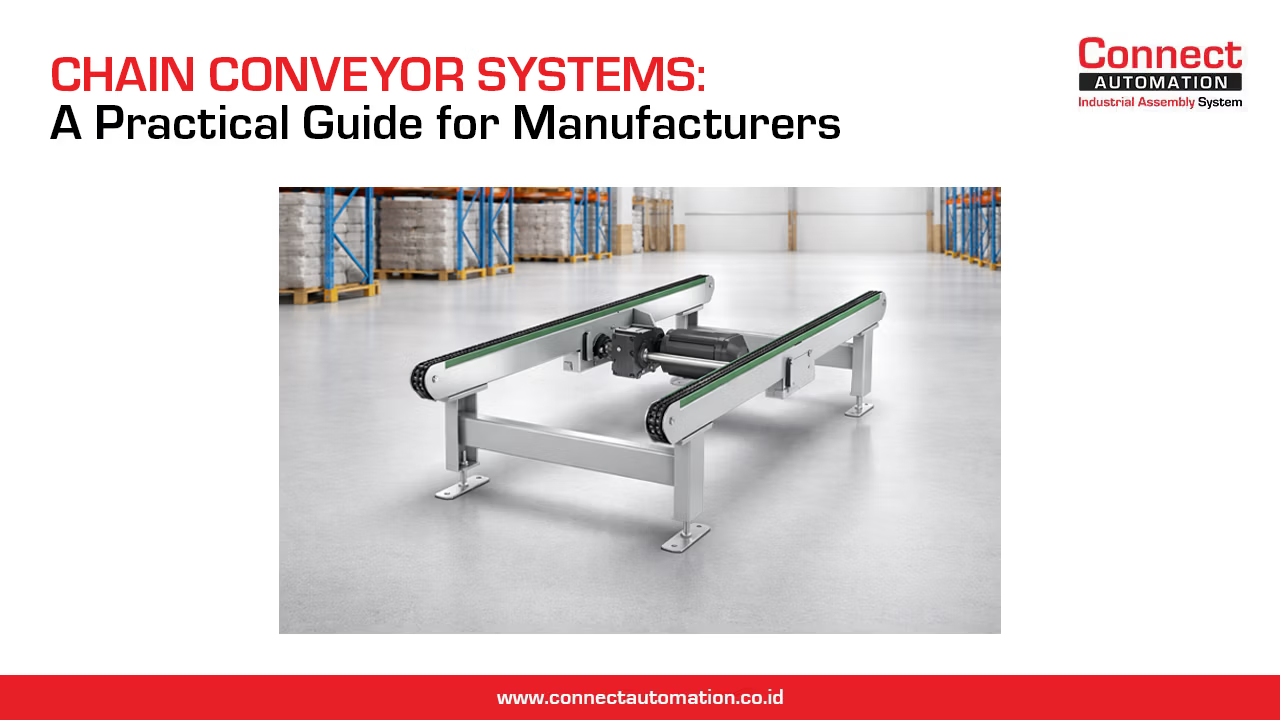
If you’re moving products through a factory—especially in wet, oily, hot, abrasive, or high-duty environments—few conveyor types are as dependable as a chain conveyor. While belt conveyors are popular for general handling, chain-based systems shine when you need positive drive, repeatable indexing, and the ability to pull, accumulate, or drag product carriers through a process with confidence. In this guide we’ll break down what a chain conveyor is, where it fits best, and the common variations you’ll see in real production lines—including rod with chain conveyor, indexing tabs (dogs) for pulling product through, and pallet-on-chain approaches used for assembly and inspection lines.

What Is a Chain Conveyor?
A chain conveyor is a conveying system where one or more chains run in a continuous loop, driven by sprockets. The chain may run on wear strips or guide tracks, and it can carry product directly or move attachments—such as tabs, fixtures, or pallets—through a process. Unlike friction-based systems (like many belt conveyors), a chain conveyor is built around mechanical engagement between chain and sprocket teeth. This is what makes chain conveyors ideal for:
- Heavy loads
- Harsh environments (coolant, oil, dust)
- High temperatures
- Indexing / step-by-step movement
- Pull-through and tow applications
- Long runs where belt slip would be a problem
Where Chain Conveyors Make the Most Sense
Chain conveyors are often chosen when you need one (or more) of these outcomes:
- Positive Drive and No Slip: If your product must stay synchronized with upstream/downstream machines—like a labeling station, printing station, robot pick/place, or inspection camera—a chain conveyor helps maintain consistent movement without belt slip.
- Ruggedness for Industrial Duty : Chain conveyors handle impacts and heavy loads better than most belt systems. They’re commonly used for pallet movement, metal parts, bins/totes, and fixtures.
- Indexing and Controlled Movement : Indexing means the conveyor moves product forward a precise distance, stops, then repeats. Chain conveyors pair well with index drives, sensors, and mechanical stops.
- Pulling Products Through Processes : Some applications don’t want the product “carried” so much as pulled through a station—especially when there are side guides, tooling, or operations happening around the product. That’s where tabs and rod with chain conveyor setups come in.

Common Types of Chain Conveyor Systems
There are many chain styles and layouts, but in industrial factories you’ll commonly see these categories:
A) Single-Strand Chain Conveyor
A single chain strand runs down the conveyor centerline and pulls either:
- A centered fixture
- A tow pin system
- A guided pallet
- A special attachment
Good for narrow products or guided carriers where one chain is enough.
B) Dual-Strand (Twin Chain) Conveyor
Two parallel chains run side-by-side. This is extremely common for:
- Pallet handling
- Stable product support
- Wider parts and fixtures
- Assembly lines where operators work on pallets
Twin chain conveyors can be configured so pallets sit directly on chain, or on wear strips/rails with chain lugs doing the pull.
C) Multi-Strand / Heavy Duty Chain Conveyor
Used for heavy pallets, large fixtures, and high-impact loads. Often includes robust steel structure, machined wear strips, and hardened sprockets.
Rod with Chain Conveyor: What It Is and Why It’s Used
A rod with chain conveyor is typically a system where a cross rod (or crossbar) is fixed between two parallel chains (or attached to a single chain with a stabilizing design). The rod travels with the chain and becomes a “pusher” or “tow element” that:
- Pushes product forward
- Pulls a carrier
- Moves pallets by contacting a feature underneath
- Acts like a moving “dog” across the conveyor width
This is especially useful when:
- Products are too wide to be reliably pushed from one side
- You need uniform pushing force across the width
- You’re moving a pallet or fixture that has a designed contact face
- You want a simple mechanical way to move product without adding rollers or belts
Rod systems are also popular when conveying in washdown or dirty environments, because the mechanism can be made simple, open, and easy to clean or maintain.
Key design points for rod with chain conveyor:
- Chain synchronization: If using two chains, they must stay aligned so the rod remains square.
- Rod strength and deflection: Long rods under load must be sized properly to avoid bending.
- Guiding: Product/pallet usually needs side guides or rails so the rod pushes cleanly without skewing.
- Wear surfaces: Rods sliding or contacting pallets repeatedly should have wear-resistant materials or replaceable contact pads.

Tabs for Indexing and Pulling Products Through
When customers say they want “tabs,” they usually mean chain attachments that act like dogs, lugs, or pushers. These tabs are mounted to the chain at set intervals, and as the chain moves, the tab contacts a product, tray, or pallet feature and pulls it forward. This is one of the most effective methods for:
- Indexing products into stations (exact spacing)
- Pull-through conveying where the product slides on a surface
- Moving products where the underside isn’t suitable for rollers
- Creating controlled gaps between items for packing, labeling, or scanning
How tabs help with indexing
Indexing isn’t only about the drive system—tabs make spacing repeatable. If each tab is mounted at a fixed pitch (for example every 400 mm), then every product can be advanced exactly one “tab distance” per cycle. Combined with sensors and stops, this creates very stable sequencing.
How tabs pull products through
Rather than relying on friction between belt and product, tabs provide a physical engagement point. Common setups include:
- Tab pushing the rear of a tote
- Tab engaging a notch/hole on the pallet underside
- Tab pushing a carrier that rides on wear strips
Things that matter when designing tab systems
- Tab material and shape: Needs to match the product contact surface and withstand repeated impacts.
- Mounting strength: Tabs see shock loads, especially in stop/start indexing.
- Noise and vibration: Tabs contacting products can create noise if not designed with damping or correct geometry.
- Safety guarding: Tabs create pinch points, so guarding and safety design must be considered.

Pallet Handling on Chain Conveyors
Pallet handling is a major reason manufacturers choose a chain conveyor. Pallets are used to:
- Maintain product orientation
- Carry fixtures/jigs
- Provide a stable “work surface” for assembly or inspection
- Enable stop-and-go manufacturing without disturbing the product
There are a few common ways pallets “sit on top of the chains”:
1) Pallet Riding Directly on the Chains
In some heavy-duty layouts, the pallet base contacts the chain directly. This can work well, but wear must be managed:
- Pallet underside can wear
- Chain wear increases
- Noise can be higher
This is often used when the pallet base is robust and easy to replace or refurbish.
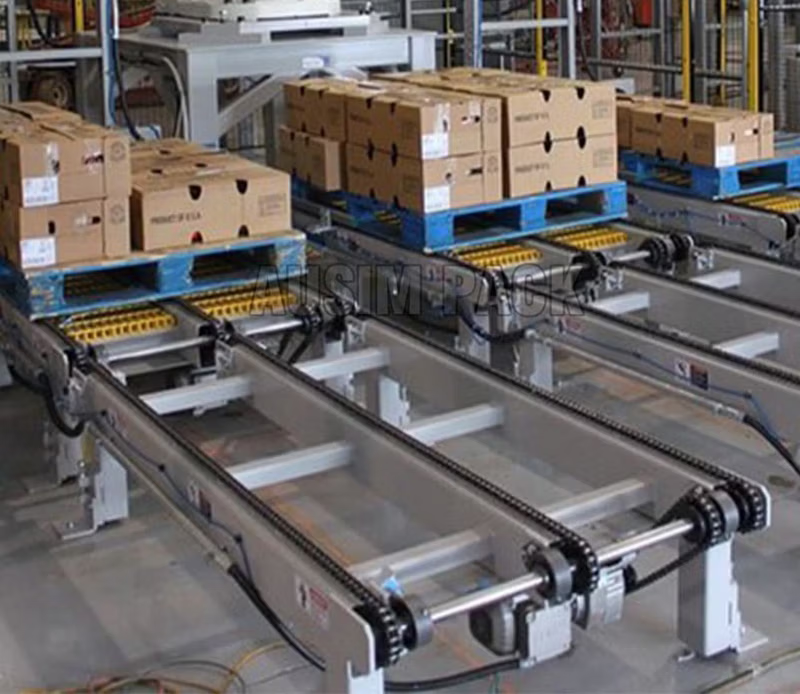
2) Pallet Riding on Wear Strips / Rails, Pulled by Chain Tabs
This is one of the most practical approaches in many factories:
- Pallet weight rides on low-friction wear strips (UHMWPE or similar)
- Chain tabs engage a tow feature under the pallet
- Pallets glide smoothly and are easier to stop at stations
This reduces chain wear and gives smoother motion.
3) Twin Chain Support with Guided Pallets
Two chains provide stable support for wider pallets. Side guides keep the pallet aligned, and the chain drive keeps movement consistent through stops, transfers, and workstations.
Why Chain Conveyors Perform Well in Assembly and Process Lines
A chain conveyor isn’t just about moving A to B. In many cases, the conveyor becomes part of the process control. Examples:
- Assembly operators working at a fixed station while pallets index forward
- Barcode scanning and vision inspection where speed consistency matters
- Accumulation zones where pallets queue safely
- Integration with lifts, stops, and transfers
Because the drive is positive, a chain conveyor can be engineered to be very predictable—especially when combined with:
- Sensors (photoelectric, proximity)
- Pneumatic stops
- Servo or VFD control
- Mechanical indexing mechanisms
Selection Tips: Getting the Chain Conveyor Right
When specifying or upgrading a chain conveyor, focus on these practical factors:
Load and duty cycle
- Total pallet weight (including fixture + product)
- Peak impact loads (start/stop)
- Cycles per hour and operating hours per day
Environment
- Wet/washdown vs dry
- Dust, abrasive particles, chips
- Oils, chemicals, temperature
Required control
- Continuous run vs indexing
- Needed accuracy of stop position
- Throughput targets and buffer capacity
Maintenance and wear parts
A good chain conveyor design makes wear parts easy to access and replace:
- Wear strips
- Sprockets
- Chain tensioners
- Tabs / attachments
- Guides and rails
Why Choose Connect Automation for Chain Conveyor Solutions?
At Connect Automation, we design and integrate chain conveyor systems to suit real manufacturing conditions—where uptime, maintenance access, and predictable movement matter. Whether you need a rugged conveyor for pallets, a precise indexing solution with tabs, or a rod with chain conveyor concept to pull products through a process station, the right design choices up front will save time and cost long-term. If you’re planning a new line or upgrading an existing conveyor, the best next step is to define:
- Product and pallet dimensions
- Load weights and throughput target
- Process stations (stops, indexing, scanning, assembly)
- Environment and cleaning requirements
From there, a chain conveyor can be engineered into a reliable backbone for your production flow.
Connect Automation specializes in providing automation solutions, including conveyor systems, to improve efficiency across various industries. The company delivers cutting-edge technology to help organizations automate tasks and optimize workflows. Connect Automation helps businesses reduce manual efforts, boost productivity, and achieve better outcomes. With a customer-focused approach, the company designs tailored solutions to ensure smooth and effective automation transitions for long-term success.
Kawasan Industri Jababeka Tahap 1, Jl. Jababeka II D Blok C14L Cikarang, Indonesia (17530)
(021) 893 5060 Google Maps
Rungkut Industri III, No. 37, Rungkut Menanggal, Kec. Gn. Anyar Surabaya, Indonesia (60293)
(031) 9985 8624 Google Maps