
REQUEST A FREE ESTIMATE!
Calculate Conveyor Capacity Based on Hourly Production Targets
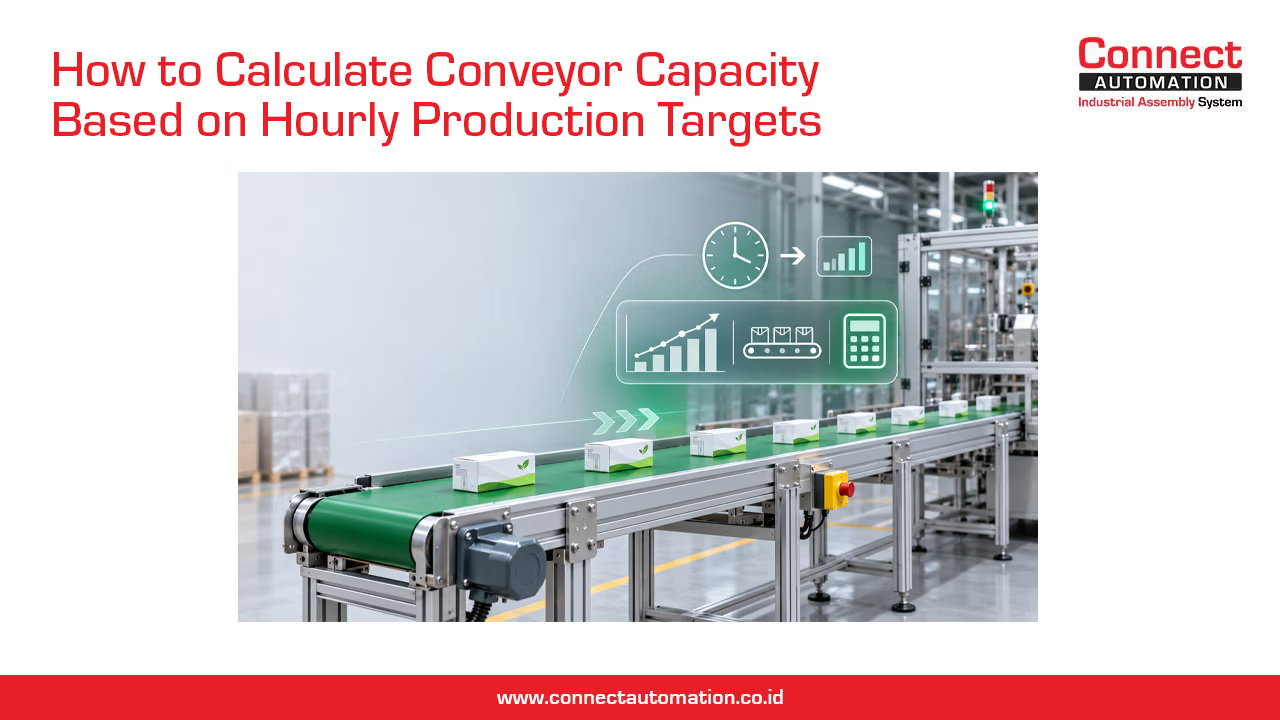
In industrial production lines, conveyors play an essential role in transporting products from one process to another. However, selecting a conveyor involves more than determining its length, width, or construction material. One important parameter is conveyor capacity, which refers to the number of products that can be transported within a specific period.
For example, a beverage manufacturing facility may have a production target of 6,000 bottles per hour. To support this output, the conveyor must transport bottles at an appropriate speed without causing excessive accumulation or compromising product stability.
A conveyor that operates too slowly may restrict product flow, while increasing conveyor speed does not necessarily improve production output. Excessive speed can introduce additional challenges, including unstable bottles, product misalignment, and transfer problems.
So, how do you calculate conveyor capacity based on production targets?
By understanding the required production throughput, product dimensions, and spacing between products, engineers can estimate the necessary conveyor speed using a straightforward calculation.
This article explains the basic conveyor capacity formula and provides practical examples for bottles, cartons, and multi-lane conveyor systems.
1. Why Should Conveyor Capacity Match Production Targets?
Conveyor capacity indicates how many products a conveyor system can transport over a given period. For production lines handling individual items, capacity is commonly expressed in pieces per hour (pcs/hour) or pieces per minute (pcs/min). For example, if a filling machine produces 100 bottles per minute, the downstream conveyor must have sufficient transport capacity to receive and move those bottles toward the next process.
If the conveyor's transport capacity is lower than the filling machine's output, products may begin accumulating upstream. However, excessively increasing conveyor speed is not always the correct solution. For tall bottles, cans, or lightweight packages, speed changes and transfer conditions may affect product stability.
It is therefore important to distinguish between three parameters:
- Production target: The number of products a facility aims to produce within a specific period, such as 6,000 bottles/hour.
- Theoretical conveyor capacity: The number of products that can theoretically be transported based on conveyor speed and product spacing.
- Actual production output: The number of products actually produced after accounting for operational conditions throughout the production line.
These parameters are related, but their values are not necessarily identical. A conveyor with a theoretical capacity of 8,000 bottles/hour will not automatically enable a production line to achieve that output if the filling machine can only produce 6,000 bottles/hour.
For this reason, conveyor capacity calculations should consider both product flow requirements and the capabilities of connected production equipment. For further discussion about production performance, explore our article on Standard Conveyors for Achieving Daily Production Targets.
2. Factors Affecting Conveyor Capacity
Before calculating conveyor capacity, several parameters must be identified to obtain results that reflect the intended production requirements.
Hourly Production Target
The production target represents the number of products that must be transported within a specific period. Examples include:
- Filling machine: 6,000 bottles/hour.
- Packaging machine: 1,200 cartons/hour.
- Labeling machine: 4,800 bottles/hour.
- Cartoning machine: 900 cartons/hour.
These values provide the basis for determining the required conveyor transport capacity.
However, engineers should identify whether the specified production rate represents the machine's maximum capacity, normal operating rate, or average production target. This distinction matters because conveyor sizing should reflect the expected product flow under the intended operating conditions.
Product Dimensions and Orientation
Product dimensions influence how many items can occupy a given length of conveyor. For individual products moving in a single-file arrangement, the relevant dimension is the product length in the direction of conveyor travel.
For example, consider a carton with the following dimensions:
- Length: 400 mm.
- Width: 300 mm.
- Height: 250 mm.
If the carton travels with its 400 mm side aligned with the conveyor direction, the effective product length is 400 mm. However, if the carton is rotated so that its 300 mm side aligns with the travel direction, the effective length becomes 300 mm.
This change in orientation can affect theoretical capacity even though the carton's physical dimensions remain unchanged. For cylindrical products such as bottles and cans, product diameter is commonly used as a starting point for estimating the spacing required in a single-file flow.
Product Spacing and Product Pitch
In addition to product dimensions, the spacing between consecutive items is an important factor in conveyor capacity calculations. In conveyor engineering, product pitch refers to the distance between corresponding reference points on two consecutive products.
For products arranged with a consistent orientation, pitch can be calculated by adding the product length to the clear gap between products. For example:
- Carton length: 300 mm.
- Clear gap between cartons: 100 mm.
- Product pitch: 400 mm.
With a pitch of 400 mm, each carton occupies 0.4 meters of conveyor length. At a constant conveyor speed, increasing product pitch reduces the number of products that can pass a given point per hour.
Conversely, reducing the pitch increases theoretical throughput, provided that product stability and process requirements are maintained.
Conveyor Speed
Conveyor speed refers to the linear speed of the belt, modular belt, or chain carrying the products. Common units include:
- Meters per minute (m/min).
- Meters per second (m/s).
For hourly production capacity calculations, meters per minute is convenient because it can be directly related to the number of products transported per minute.
The basic relationship is:
Higher conveyor speed results in greater theoretical capacity when product pitch remains constant.
However, increasing speed must still account for product stability, component operating limits, and downstream machine capabilities.
Number of Conveyor Lanes
The number of conveyor lanes also affects total transport capacity. A single-lane conveyor transports products along one path, while a multi-lane conveyor allows products to move through multiple paths simultaneously.
For example, two lanes capable of transporting 6,000 bottles/hour each provide a combined theoretical capacity of 12,000 bottles/hour. However, this combined capacity can only be achieved if the products are distributed appropriately and downstream equipment can handle the total flow.
3. Conveyor Capacity Calculation Formula
For conveyors transporting individual products in a continuous sequence, theoretical capacity can be estimated from conveyor speed and product pitch. The following calculations apply to continuous, single-lane product flow, assuming that the products move at the conveyor's linear speed and maintain a relatively constant pitch.
Calculating Conveyor Capacity from Conveyor Speed
The basic formula is:
Where:
- Q = theoretical conveyor capacity (pcs/hour).
- v = conveyor speed (m/min).
- P = product pitch (m/product).
- 60 = conversion factor from minutes to hours.
For example, consider a conveyor operating at 12 meters per minute with a product pitch of 0.2 meters.
Q = (60×12)/0.2 = 3,600 pcs/hour
This means the conveyor has a theoretical transport capacity of 3,600 products per hour under continuous-flow conditions. This value does not guarantee actual production output because interruptions and downstream limitations have not been considered.
Calculating Conveyor Speed from Production Targets
When the required hourly throughput is known, the formula can be rearranged to determine the necessary conveyor speed.
Where:
- v = conveyor speed (m/min).
- Q = required product throughput (pcs/hour).
- P = product pitch (m/product).
This formula helps engineers estimate the required conveyor speed before proceeding with detailed drive system selection.
Calculating Product Pitch
For products with consistent orientation and defined clear spacing, product pitch can be calculated using:
Where:
- P = product pitch (m).
- L = product length in the direction of travel (m).
- G = clear gap between consecutive products (m).
For example:
Carton length = 300 mm.
Clear gap = 100 mm.
P = 300+100 = 400 mm
Convert the result into meters:
P=0.4 m
This value can then be used in the capacity or conveyor speed formula.
Important: The spacing used in the calculation must represent the spacing that can actually be maintained during operation. If products shift, accumulate, or slip relative to the conveyor surface, actual throughput may differ from the theoretical result.
4. Practical Conveyor Capacity Calculation Examples
The following examples demonstrate how the formulas can be applied to common industrial conveyor applications.
Example 1: Calculating Conveyor Speed for Beverage Bottles
A beverage production facility operates a filling machine with a target output of 6,000 bottles per hour. The bottles will be transported to the next production process using a conveyor with a planned product pitch of 150 mm.
The operating parameters are:

Using the formula:
Substitute the values:
v = (6,000×0.15)/60 =15 m/min
Result: The theoretical required conveyor speed is 15 meters per minute.
This means that a single-lane conveyor operating continuously with a product pitch of 150 mm requires approximately 15 m/min to transport 6,000 bottles per hour. However, this value is an initial estimate.
In actual production, bottle spacing may change when products pass through transfer sections or accumulation areas. Operating speed must therefore be evaluated according to bottle characteristics, conveyor layout, and downstream machine capabilities. In filling line applications, conveyor speed selection should also consider synchronization between filling, capping, labeling, and packaging machines.
Example 2: Calculating Belt Conveyor Speed for Cartons
A packaging line produces 1,200 cartons per hour. The cartons will be transported by a belt conveyor toward the next process.
The required parameters are:
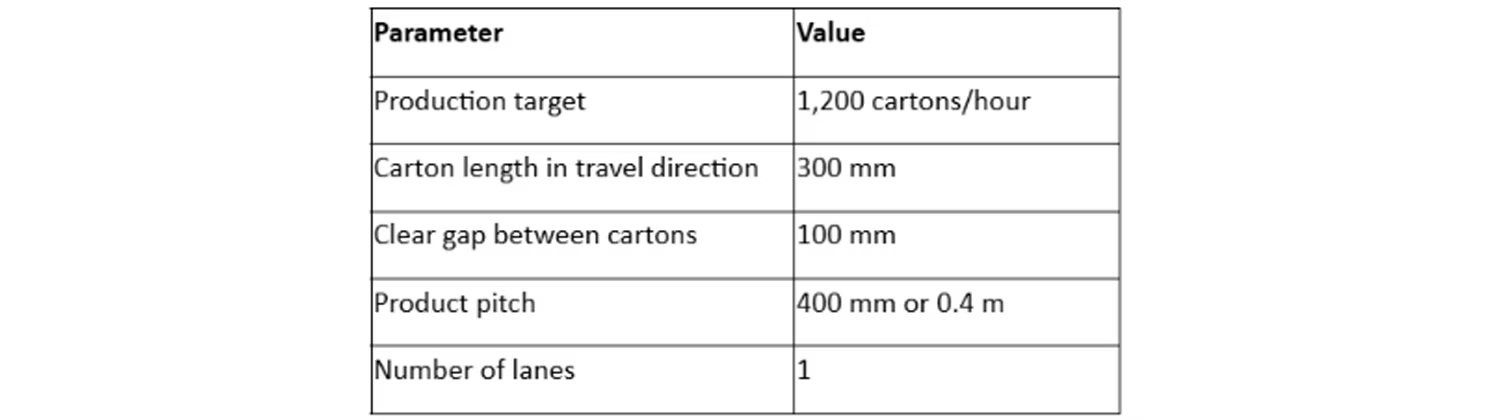
First, calculate the product pitch:
P = 300+100 = 400 mm = 0.4 m
Next, calculate the conveyor speed:
v = (1,200×0.4)/60 = 480/60 = 8 m/min
Result: The belt conveyor requires a theoretical speed of 8 meters per minute.
At this speed, the conveyor can theoretically transport 1,200 cartons per hour if each carton maintains a 400 mm pitch and the flow remains continuous. This calculation can serve as an initial basis for determining belt conveyor specifications.
However, final selection must also account for carton weight, belt width, product stability, and transfer conditions.
Example 3: Calculating Multi-Lane Conveyor Capacity
A beverage production line requires a transport capacity of 12,000 bottles per hour. To meet this requirement, a two-lane conveyor arrangement is being considered.
For this example, assume that the products are distributed equally between the two lanes. The parameters are:
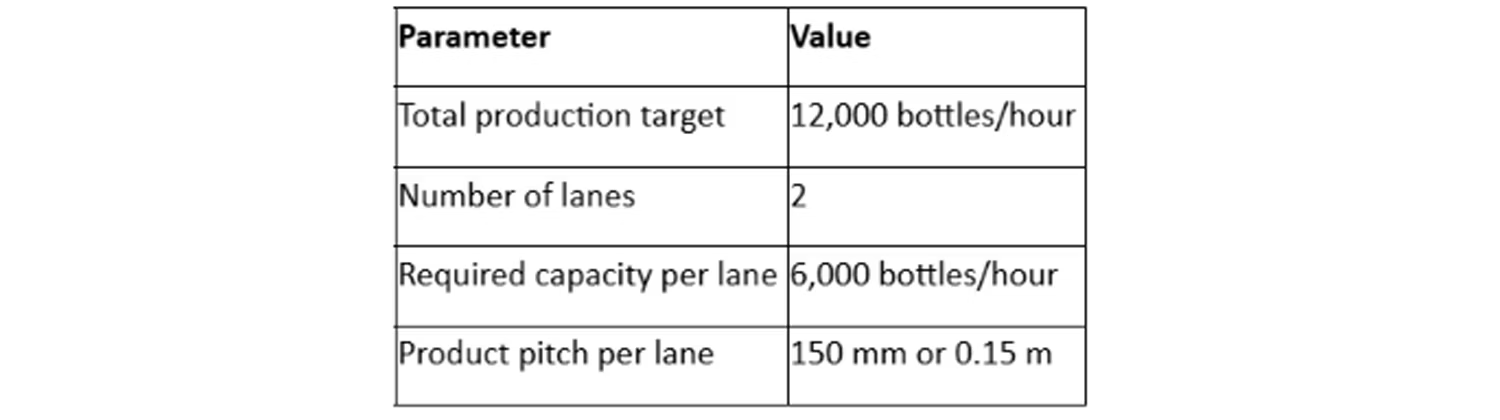
First, calculate the required capacity for each lane:
Qlane = 12,000/2 = 6,000 bottles/hour
Then calculate the required conveyor speed:
v = (6,000×0.15)/60 = 15 m/min
Result: Each lane requires a theoretical conveyor speed of 15 meters per minute.
With both lanes operating simultaneously, the combined theoretical transport capacity is 12,000 bottles/hour. This example illustrates how distributing products across multiple lanes can support a higher total transport capacity.
However, multi-lane systems also require evaluation of product distribution, lane control, and merging arrangements. If both lanes must merge into a single lane before entering a packaging machine, the merging section must be capable of handling the combined flow.
Without sufficient downstream capacity, adding conveyor lanes will not automatically increase total production output.
Summary of Conveyor Capacity Calculations
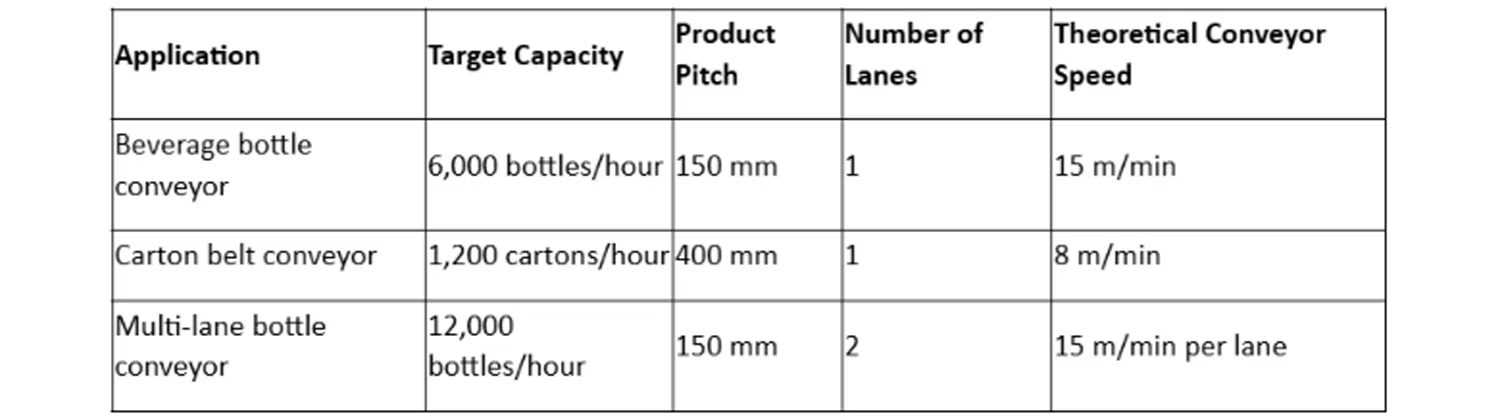
These examples demonstrate that the required conveyor speed depends not only on hourly production targets but also on product pitch and the number of lanes.
5. Why Does Theoretical Conveyor Capacity Differ from Actual Throughput?
Theoretical conveyor capacity is calculated under ideal operating assumptions. In real production environments, product flow is not always continuous, and spacing between products may vary.
Several factors can cause actual throughput to differ from calculated capacity.
Differences Between Upstream and Downstream Machine Capacities
Conveyors often connect machines with different operating capacities. Consider the following example:
- Filling machine: 6,000 bottles/hour.
- Labeling machine: 5,400 bottles/hour.
- Conveyor: theoretical capacity of 7,200 bottles/hour.
Although the conveyor can theoretically transport 7,200 bottles/hour, the labeling machine can only process 5,400 bottles/hour. If the filling machine continues producing 6,000 bottles/hour, there is a capacity difference of 600 bottles/hour.
Without appropriate flow control or temporary accumulation capacity, products will continue accumulating between the two machines. In this situation, increasing conveyor speed does not eliminate the underlying production capacity mismatch.
Changes in Product Spacing
The product pitch used in the calculation may not remain constant throughout the conveyor system. Spacing can change due to:
- Transfers between conveyors.
- Speed differences between conveyor sections.
- Product spacing control systems.
- Temporary product stops.
- Accumulation processes.
When the actual product pitch differs from the initial assumption, the number of products passing a given point per hour also changes. For existing conveyor systems, measuring actual product pitch can improve the accuracy of capacity evaluations.
Machine Interruptions and Downtime
In industrial production, conveyors and connected machines may occasionally stop due to operational requirements or unexpected interruptions. Examples include:
- Packaging material changes.
- Quality inspections.
- Product jams.
- Accumulation sensor signals.
- Downstream machine interruptions.
- Maintenance activities.
These interruptions reduce the number of products transported during the measurement period. For example, consider a conveyor with a theoretical capacity of 6,000 products/hour that receives products for only 50 minutes during a one-hour period.
Assuming the conveyor receives products at its full theoretical rate whenever it is operating:
Q actual = (6,000×50)/60 = 5,000 products/hour
This simplified example demonstrates how effective operating time influences actual throughput. In practice, actual output may also be affected by changing product pitch, product availability, and the capacities of connected machines.
The Role of Accumulation Conveyors
In production lines where connected machines operate at different speeds or experience temporary interruptions, accumulation conveyors can provide temporary product storage. These systems allow products to accumulate when downstream machinery slows down or stops.
However, an accumulation conveyor does not increase the maximum processing capacity of a bottleneck machine. Its purpose is to help manage temporary flow differences and reduce the impact of short interruptions while buffer capacity remains available.
For a more detailed explanation, read What Is an Accumulation Conveyor and How Does It Support Production?.
6. Common Calculation Mistakes and Conveyor Capacity Checklist
Although the basic conveyor capacity formula is straightforward, several common mistakes can lead to inaccurate estimates.
Common Mistakes When Calculating Conveyor Capacity
1. Using product length without considering spacing
If a carton is 300 mm long and the clear gap between cartons is 100 mm, the correct product pitch is 400 mm, not 300 mm. Ignoring the gap results in an overestimated theoretical capacity.
2. Mixing measurement units
The formula uses conveyor speed in meters per minute and product pitch in meters. If product dimensions are specified in millimeters, they must be converted before calculation.
For example:
150 mm = 0.15 m.
3. Assuming theoretical capacity equals actual production output
Theoretical capacity represents transport capability under specific assumptions. Actual production output still depends on upstream equipment, downstream equipment, machine interruptions, and operating conditions.
4. Ignoring product orientation
A carton measuring 400 × 300 mm requires different product pitches depending on which side is aligned with the conveyor direction.
5. Increasing speed without evaluating product stability
Higher conveyor speed does not always improve product handling. Tall, lightweight, or unstable products may require additional consideration at transfer points and speed transitions.
6. Assuming multiple lanes automatically increase output
Additional lanes may increase theoretical transport capacity, but total production output remains limited by the equipment receiving the products.
7. Ignoring the difference between continuous and intermittent operation
The basic capacity formula is most suitable for products moving continuously at a relatively constant pitch. For indexing conveyors or systems that move and stop periodically, calculations must also consider cycle time and the number of products transferred per cycle.
Conveyor Capacity Planning Checklist
Before selecting conveyor specifications, the following information should be available.
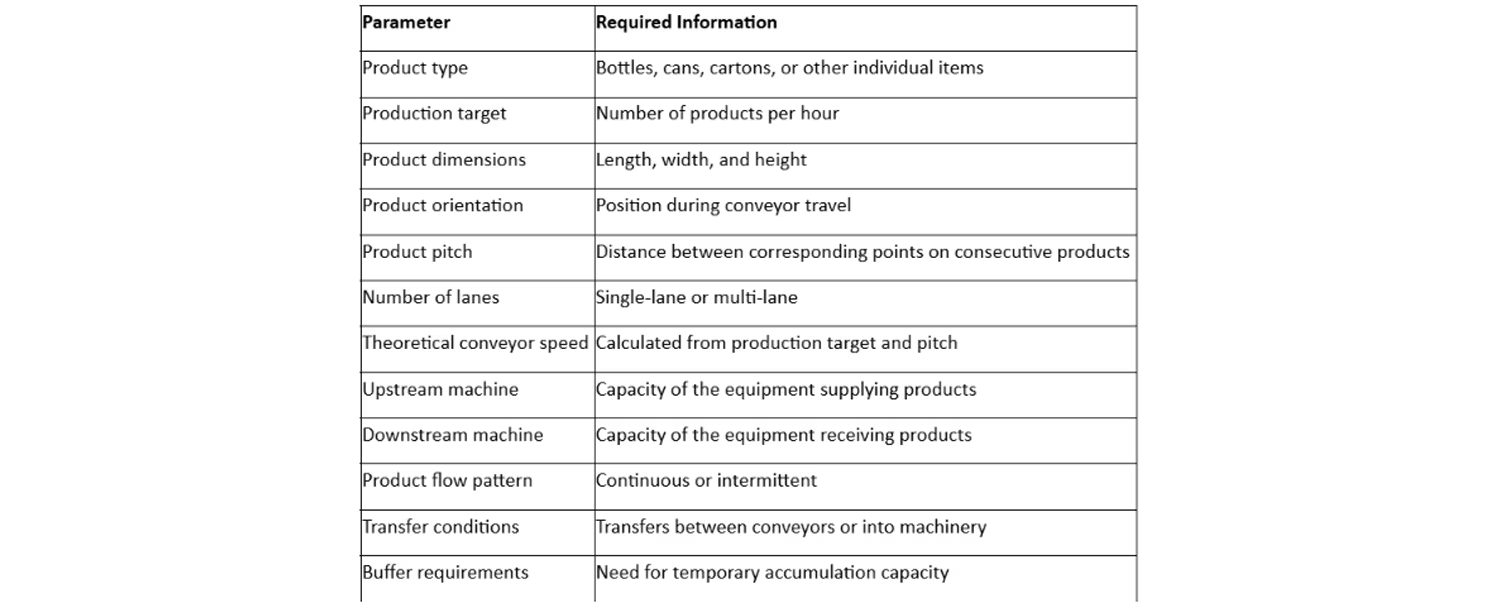
This information provides a useful starting point for conveyor selection. Once the required throughput and speed have been established, further engineering considerations include drive system selection, conveyor structure, belt or chain dimensions, and product stability.
Conveyor capacity calculations do not replace motor and gearbox calculations, as these involve different engineering parameters.
7. Conclusion
Calculating conveyor capacity based on production targets is an important step before determining conveyor speed and selecting industrial conveyor specifications. For conveyors transporting individual products in a continuous flow, theoretical capacity can be estimated using three main parameters: hourly production throughput, product pitch, and conveyor speed.
The formula:
can be used to estimate theoretical conveyor capacity, while:
helps determine the required conveyor speed based on a production target.
However, these calculations provide initial estimates rather than guaranteed production output. Actual throughput depends on product flow conditions, transfer stability, operating time, and the capacities of upstream and downstream machines.
The right conveyor is not simply the fastest conveyor, but one that can transport products at the required capacity while maintaining stable production flow.
By understanding the relationship between production targets, product dimensions, spacing, and conveyor speed, engineering teams can make more informed decisions when planning material handling systems.
Discuss Your Industrial Conveyor Requirements with Connect Automation
Connect Automation provides a range of industrial conveyor solutions, including belt conveyors, modular conveyors, table top chain conveyors, and roller conveyors for production and material handling applications.
Selecting the right conveyor requires consideration of product type, dimensions, transport capacity, speed, and operating conditions. Contact the Connect Automation team to discuss conveyor specifications that match your production targets and industrial requirements.
Explore Connect Automation's Conveyor Products and Solutions
Connect Automation specializes in providing automation solutions, including conveyor systems, to improve efficiency across various industries. The company delivers cutting-edge technology to help organizations automate tasks and optimize workflows. Connect Automation helps businesses reduce manual efforts, boost productivity, and achieve better outcomes. With a customer-focused approach, the company designs tailored solutions to ensure smooth and effective automation transitions for long-term success.
Kawasan Industri Jababeka Tahap 1, Jl. Jababeka II D Blok C14L Cikarang, Indonesia (17530)
(021) 893 5060 Google Maps
Rungkut Industri III, No. 37, Rungkut Menanggal, Kec. Gn. Anyar Surabaya, Indonesia (60293)
(031) 9985 8624 Google Maps