REQUEST A FREE ESTIMATE!
Connect Automation - Best Industrial Partner in Indonesia
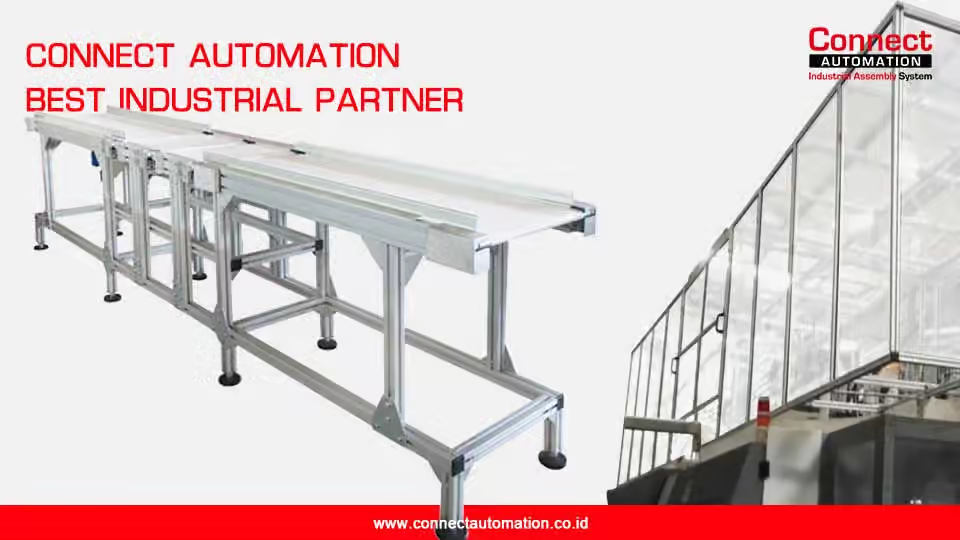
Connect Automation is premium conveyor and aluminium framing manufacturer that provides a wide range of standard conveyors fulfilling what your industry needs. Besides conveyor, Connect Automation also provides aluminium framing with standard design such as workstations, safety guardings, enclosures, trolleys and many more.
Product & Services Location
Connect Automation which provides conveyor and aluminium frame products, have offices and assembly center in Surabaya, Cikarang and Semarang. Not only in Java island, Connect Automation can and have provided high quality products across Indonesia.
Having local offices and assembly capabilities also supports project coordination, installation, and technical assistance closer to the customer's production site. This can be useful when a conveyor system requires onsite assembly, adjustment, integration with existing equipment, or technical support after installation.
For a broader understanding of how local conveyor manufacturers can support production requirements, see our article about conveyor manufacturers and local support in Indonesia.
Our Parts
We have a really wide range of spare parts, ranging from aluminium profiles which are available from 20 Series to 60 Series, wide range of nuts and bolts of all size and types, brackets and anchor connectors which are compatible for aluminium profiles, up to conveyor's motor and conveyor's speed control. All these parts have been tested in its reliability and which we also used in our assembly of high quality conveyor and aluminium frames. We also make these parts available to customers in need, so not only we manufacture the conveyors, Connect Automation also provide the complete spare parts.
The availability of components and spare parts is also important for keeping conveyor systems operational over time. Depending on the application, maintenance may involve replacing or adjusting components such as belts, rollers, motors, speed controls, brackets, or other supporting parts. Having access to compatible components can make maintenance and troubleshooting more practical when the conveyor is already in operation.
For more information about the components used in conveyor systems, see our guide to conveyor parts and how they work.
Standard Conveyor
We take great pride in our standard conveyor design. While the reliability is proven, our standard conveyors are also durable and flexible in terms of adding features such as workstation on the end or along the conveyor, conveyor's side guides and anything else. Our standard conveyors also have conveyor legs which comes in many variants such as: bolted to the floor, have wheels or regular legs that can be made adaptive for uneven floor.
-
Connect Automation provide conveyors of many types such as:
- Belt conveyor
Belt conveyor is one of the most flexible conveyor systems and is widely used for moving different types of products in production lines and material handling applications. It can be used for products with various sizes and characteristics, from lightweight products to transfers between different production processes. Belt conveyors can also be configured for horizontal or inclined applications according to the production layout.
Learn more about belt conveyor definitions, functions, and how they work in material handling systems. - Roller conveyor
Roller conveyor is commonly used for material handling applications involving products with a relatively stable bottom surface. It is widely applied in warehouses, packaging areas, distribution processes, and transfers between workstations. Gravity roller and powered roller configurations can be selected according to product weight, movement requirements, and the need for a powered drive system.
Learn more about roller conveyors and the different types used in material handling systems. - Incline conveyor / decline conveyor
Incline and decline conveyors are used when products need to move between different elevations within a production or material handling system. They can connect processes located at different heights, including floor-to-floor transfers or transfers to the next production stage.
The conveyor configuration should be selected according to the product characteristics, required inclination, available space, and overall production flow. - Curve conveyor
Curve conveyors are used when a production or material handling line requires a change in direction without manually transferring products between conveyors. This configuration can help follow the layout of a facility and create a more continuous product flow in areas where space or equipment positioning requires a directional change.
The curve configuration should be selected according to the product characteristics, conveyor type, and required movement through the production line. - Modular conveyor
Modular conveyor is commonly used in production lines that require a modular belt system that is practical to maintain and can be configured according to product characteristics and production requirements. It can be applied in various industries, including food processing, plastic products, packaging, and processes that require cleaning or washdown.
For applications involving wet food production, see our article about modular conveyors for hygienic wet food production. We also discuss the use of modular conveyors for plastic products with different product characteristics. - Table top chain conveyor
Table top chain conveyor is widely used in production lines handling packaged products, particularly in industries such as FMCG, food and beverage, beverage, pharmaceutical, and packaging. This type of conveyor is suitable for applications that require stable and controlled product movement between processes, including the transfer of bottles, cans, containers, and other packaged products.
The chain and frame materials can be selected according to product characteristics and operating conditions. Learn more about table top chain conveyors and their industrial applications, as well as our guide to selecting the right chain and frame for a table top chain conveyor. - Stainless steel conveyor
Stainless steel conveyors are commonly considered for applications that require corrosion resistance, cleanliness, and easier cleaning, particularly in food and beverage, pharmaceutical, and applications involving frequent washdown.
The appropriate stainless steel grade should also be considered based on the operating environment and application requirements. Learn more about stainless steel 304 vs 316 for conveyor applications to understand the differences between these commonly used grades. - Steel conveyor
Steel conveyors can be used for material handling applications where the characteristics of the frame material are suitable for the load and operating conditions. Material selection should consider product weight, working environment, structural requirements, and the required protection or finishing of the conveyor frame.
Conveyor Manufacturing and Fabrication
Connect Automation provides industrial conveyor manufacturing and fabrication for production and material handling applications. The available solutions include belt conveyors, roller conveyors, modular conveyors, table top chain conveyors, as well as conveyor systems using aluminium profiles, stainless steel, or steel, depending on the requirements of the application.
The fabrication approach starts by understanding the product, production flow, operating environment, required dimensions, and integration requirements. Based on these factors, the conveyor type, material, configuration, and supporting components can be selected to create a system that fits the production line.
Not every application requires a conveyor with specially manufactured components. Standard conveyor systems can often provide a practical solution when their specifications and configuration already meet the production requirements. Where necessary, dimensions, layout, and certain configurations can be adjusted within the capabilities of the standard system.
The process can also include assembly, testing, installation, and integration with existing production equipment, depending on the project scope. This allows conveyor fabrication to be considered not simply as the manufacturing of a conveyor unit, but as part of implementing a conveyor system within an existing production environment.
For a more detailed explanation of conveyor types, materials, fabrication processes, and considerations when choosing a fabrication vendor, see our guide to industrial conveyor fabrication.
Choosing the Right Conveyor for Your Application
Choosing a conveyor system should begin with the application rather than with the conveyor type alone. The product characteristics, production flow, required capacity, operating environment, and available layout can all influence the appropriate conveyor configuration. Some of the factors that should be considered include:
- Product type, dimensions, and weight
- Required conveyor speed and production capacity
- Conveyor length, width, and height
- Production line layout
- Environmental conditions
- Cleaning and washdown requirements
- Required frame and conveyor material
- Product stability during transfer
- Integration with existing machines or equipment
- Maintenance and accessibility requirements
For example, belt conveyors may be suitable for general product transfer, while roller conveyors can be useful for products with an appropriate bottom surface. Modular and table top chain conveyors can provide different solutions for production lines handling packaged products, depending on the product characteristics and production process.
The right conveyor is therefore not determined by one specification alone. The system should be evaluated based on how it will operate within the complete production flow.
Conveyor Manufacturing Process
The manufacturing process of a conveyor can involve several stages, depending on the application and project scope. In general, the process starts with understanding the production requirements, followed by conveyor configuration, material selection, fabrication, assembly, testing, and installation.
At the fabrication stage, the frame and other required components are prepared according to the selected configuration. The conveyor is then assembled and tested before being installed or integrated into the production line. For projects that involve existing machines or equipment, the installation stage may also include adjustments to ensure that the conveyor works properly within the overall production flow.
The exact scope of each project can vary depending on the conveyor type, application, and installation requirements. For a more detailed look at each stage, see our guide to conveyor fabrication for industrial applications.
Installation, Assembly and After-Sales Support
A conveyor project does not always end when the conveyor has been manufactured. Depending on the project requirements, the scope may also include assembly, installation, integration, adjustment, and initial testing at the customer's facility.
For systems that require onsite assembly, individual conveyor sections can be positioned and connected at the production site before the system is adjusted and integrated with the existing production line. This can be particularly relevant when the conveyor has a specific layout or needs to be installed within an existing production environment.
After installation, ongoing support can also be important for maintaining conveyor performance. Maintenance, troubleshooting, adjustment, spare parts, and technical assistance may be required as the production line operates and its requirements change over time.
By combining manufacturing capabilities with assembly, installation, and after-sales support, conveyor projects can be managed with greater continuity from the initial configuration through to operation and maintenance.
For a more detailed explanation of conveyor fabrication, assembly, installation, and vendor considerations, see our guide to industrial conveyor fabrication.
Free Consultation
If our standard conveyor haven't fulfill your needs or you are still hesitant about the conveyors, fear not! Whatever your needs or issuess, Connect Automation is more than willing to serve and provide products that meet your needs by consulting with our sales team which is free of charge a.k.a profit. Our sales team has broad experience and extensive product knowledge which disables us from giving anything but the best recommendation for your industrial needs.
If you are unsure which conveyor type, material, or configuration is suitable for your production line, consultation can help identify the requirements before the conveyor is manufactured and installed.
Connect Automation specializes in providing automation solutions, including conveyor systems, to improve efficiency across various industries. The company delivers cutting-edge technology to help organizations automate tasks and optimize workflows. Connect Automation helps businesses reduce manual efforts, boost productivity, and achieve better outcomes. With a customer-focused approach, the company designs tailored solutions to ensure smooth and effective automation transitions for long-term success.
Kawasan Industri Jababeka Tahap 1, Jl. Jababeka II D Blok C14L Cikarang, Indonesia (17530)
(021) 893 5060 Google Maps
Rungkut Industri III, No. 37, Rungkut Menanggal, Kec. Gn. Anyar Surabaya, Indonesia (60293)
(031) 9985 8624 Google Maps