
REQUEST A FREE ESTIMATE!
Types of Safety Guarding in Industry and Their Functions
Understanding Different Types of Safety Guarding in Production Systems
In modern production systems, safety guarding cannot be implemented arbitrarily. Each machine, workflow, and level of risk requires a different approach to protection. Therefore, understanding the types of safety guarding is a crucial step in determining the most appropriate system.
Choosing the wrong type of guarding can not only compromise safety but also disrupt operational efficiency. In manufacturing environments with dense activity, achieving the right balance between safety and accessibility is essential.
General Classification of Safety Guarding
In general, safety guarding can be divided into two main categories:
- Physical guarding (passive) → acts as a physical barrier
- Active guarding (system-integrated) → works together with sensors and control systems
In modern industrial applications, these two approaches are often combined to create a more effective and reliable safety system.
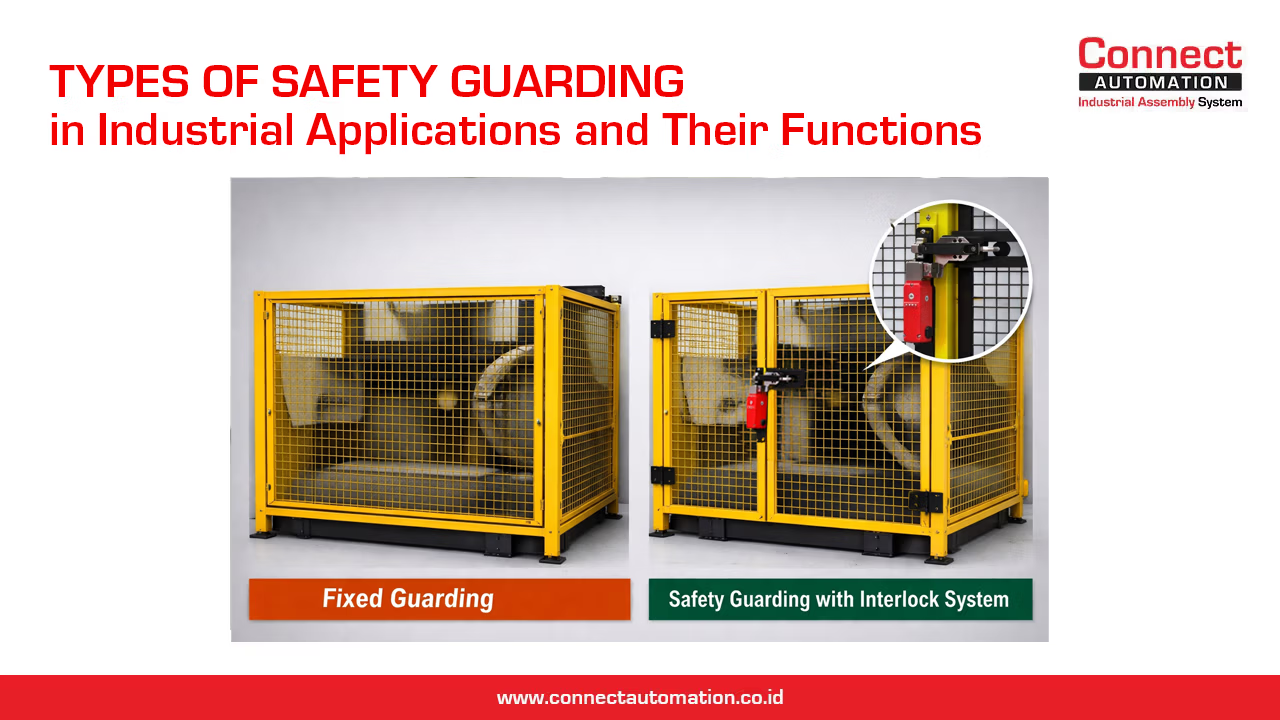
Fixed Guard
A fixed guard is a type of safety guarding that is permanently installed and cannot be removed without tools.
Function:
To protect areas of machinery that do not require routine operator access.
Advantages:
- Simple and robust design
- Minimal maintenance
- Provides maximum protection for static areas
Limitations:
- Not flexible for access needs
- Can make maintenance more difficult
Typical Applications:
- Conveyor pulley covers
- Rotating shafts
- Machine parts that do not require operator interaction
Interlocked Guard
An interlocked guard is connected to the machine control system. When the guard is opened, the machine automatically stops.
Function:
To protect areas that still require operator access during operation or maintenance.
Advantages:
- High level of safety
- Allows controlled access when needed
- Suitable for automated systems
Limitations:
- More complex implementation
- Requires integration with control systems
Typical Applications:
- Automated and semi-automated machines
- Robot cells
- Enclosures with access doors
Adjustable Guard
An adjustable guard is designed to be manually adjusted according to operational needs.
Function:
To provide flexibility in processes involving varying product sizes or materials.
Advantages:
- Flexible and adaptable
- Suitable for operations with high variability
Limitations:
- Depends on correct operator adjustment
- Higher risk of human error
Typical Applications:
- Cutting machines
- Manual processing equipment
Self-Adjusting Guard
A self-adjusting guard automatically adjusts its position based on the movement of material during machine operation.
Function:
To provide dynamic protection without interrupting the workflow.
Advantages:
- Practical and efficient
- Reduces the need for manual adjustment
Limitations:
- Not suitable for all machine types
- Requires more specific design considerations
Comparing Different Types of Safety Guarding
Each type of safety guarding has its own characteristics. Key comparison factors include:
- Level of accessibility
- Degree of protection
- System complexity
- Suitability for specific machine types
Selecting the right solution requires evaluating all these factors collectively, rather than focusing on just one aspect.
How to Choose the Right Safety Guarding
The selection of safety guarding should be based on actual operational conditions, such as:
- Frequency of operator access
- Type and level of machine risk
- Production flow and material movement
- Available space in the production area
In environments with high activity and limited space, choosing the appropriate type of guarding becomes even more critical to maintain both safety and efficiency.
Safety Guarding as Part of an Integrated System
In real-world applications, safety guarding is rarely used as a standalone solution. Instead, multiple types of guarding are often combined, for example:
- Fixed guards for static areas
- Interlocked guards for operator-access zones
Additionally, safety guarding is frequently integrated with sensors and interlock systems to create a more comprehensive and responsive safety system.
Conclusion
There is no single type of safety guarding that fits all situations. Each production system requires a tailored approach based on risk level, accessibility needs, and operational characteristics. By understanding the different types of safety guarding, companies can design protection systems that not only improve safety but also support smooth and efficient production processes.
Connect Automation specializes in providing automation solutions, including conveyor systems, to improve efficiency across various industries. The company delivers cutting-edge technology to help organizations automate tasks and optimize workflows. Connect Automation helps businesses reduce manual efforts, boost productivity, and achieve better outcomes. With a customer-focused approach, the company designs tailored solutions to ensure smooth and effective automation transitions for long-term success.
Kawasan Industri Jababeka Tahap 1, Jl. Jababeka II D Blok C14L Cikarang, Indonesia (17530)
(021) 893 5060 Google Maps
Rungkut Industri III, No. 37, Rungkut Menanggal, Kec. Gn. Anyar Surabaya, Indonesia (60293)
(031) 9985 8624 Google Maps