
REQUEST A FREE ESTIMATE!
Straight-Running vs Side-Flexing Chain Difference and Application
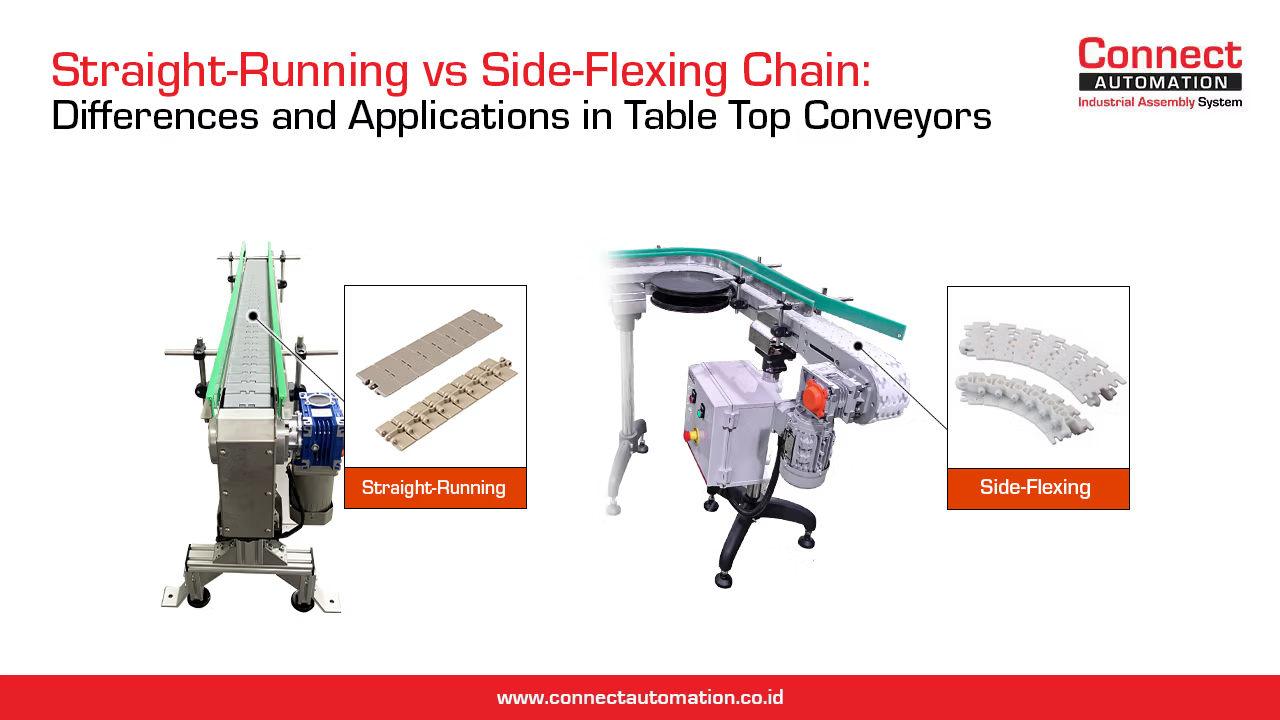
In industrial production lines, table top chain conveyors are widely used to transport bottles, cans, cosmetic containers, and various fast-moving consumer goods (FMCG). Their relatively flat conveying surfaces allow products to move in an upright position, making these conveyors suitable for connecting filling, capping, labeling, and packaging machines.
However, not all table top chains have the same movement characteristics. One important distinction is between straight-running chains and side-flexing chains.
Straight-running chains are designed for straight conveyor paths, while side-flexing chains allow conveyors to follow horizontal curves. This difference affects track construction, minimum curve radius, chain tension, and product stability during transportation.
Selecting an unsuitable chain type can increase friction, accelerate component wear, reduce product stability, and cause operational problems.
What are the differences between straight-running and side-flexing chains? How do curve radius and conveyor speed influence chain selection?
1. Why Is Chain Selection Important in Table Top Conveyors?
When designing a table top conveyor, chain selection involves more than choosing the material, chain width, or weight of the products being transported. The shape of the conveyor path is also an important consideration.
On a straight production line, the chain moves along its track without requiring horizontal changes in direction. However, when the conveyor layout includes curves, the chain must follow the changing path while continuing to support the products. These conditions create different mechanical requirements, particularly in curved sections.
Several factors are influenced by chain selection:
- Conveyor path: Whether products move along a straight route or through horizontal curves.
- Curve radius: The chain's ability to follow a curved path within its design limitations.
- Conveyor speed: The effect of speed on product stability when passing through curves.
- Chain pull: The tensile force acting on the chain during operation.
- Friction and wear: Interactions between the chain, track, and wear strips.
- Maintenance requirements: Inspection of components exposed to friction and mechanical loads.
For simple layouts, straight-running chains can provide an appropriate solution without requiring curved track construction. When the conveyor must change direction to accommodate the production layout, side-flexing chains offer the necessary lateral flexibility.
However, side-flexing chains must still operate within the manufacturer's specified limits for curve radius, loading, and operating conditions. For a broader discussion of chain materials and conveyor frame selection, read our article on Selecting Chains and Frames for Table Top Chain Conveyors.
2. Differences Between Straight-Running and Side-Flexing Chains
The primary difference between straight-running and side-flexing chains is their ability to articulate and follow different conveyor paths.
Straight-Running Chains
A straight-running chain is a type of table top chain designed to operate along straight conveyor paths. It consists of interconnected links that allow the chain to travel around sprockets and return through the conveyor's lower track.
The chain joints allow the articulation necessary to engage with sprockets, but they are not designed to follow continuous horizontal curves in the same way as side-flexing chains. Common characteristics of straight-running chains include:
- Designed for straight conveyor sections.
- Link construction allows movement around sprockets and return paths.
- Not intended for continuous horizontal curves.
- Requires compatible tracks and sprockets.
- Suitable for production lines that do not require horizontal direction changes within the same chain path.
For example, a straight-running chain conveyor may transport bottles from a filling machine to a capping machine when both machines are arranged in a straight line. This type of chain is also commonly used in packaging lines where machines are positioned along the same production path.
The main advantage of straight-running chains is their suitability for straightforward conveyor layouts without the additional requirements of horizontal curves. However, chain selection must still consider transport capacity, material, conveyor length, and operating loads.
Side-Flexing Chains
A side-flexing chain is designed to follow both straight paths and horizontal curves. Its link geometry and joint construction allow controlled lateral articulation within the limits specified by the manufacturer.
This capability enables a conveyor to change direction horizontally while maintaining a continuous chain path. Common characteristics of side-flexing chains include:
- Suitable for straight sections and horizontal curves.
- Designed with lateral articulation capabilities.
- Requires compatible tracks and guides in curved sections.
- Has a specified minimum curve radius.
- Requires consideration of friction, chain pull, and component wear.
For example, a beverage production line may have filling and labeling machines positioned at different angles within the factory layout. A side-flexing table top chain conveyor can follow the required path, provided that the curve radius and operating parameters are compatible with the selected chain.
However, side-flexing chains cannot operate at every possible curve radius. Each chain series has specific geometric and mechanical limitations.
If the radius is too small, additional mechanical loading, friction, or irregular chain movement may occur. Therefore, side-flexing chain selection should be coordinated with track design and conveyor curve geometry.
3. How Curve Radius and Conveyor Speed Affect Chain Selection
In side-flexing table top chain conveyors, curve radius is one of the most important design parameters. The radius determines how sharply the conveyor changes direction.
Understanding Conveyor Curve Radius
Curve radius describes the curvature of the conveyor path. Generally, a smaller radius produces a tighter turn, while a larger radius creates a more gradual curve.
When designing a side-flexing conveyor, it is important to distinguish between:
- Conveyor path radius: The geometric radius used in the conveyor layout.
- Minimum chain curve radius: The minimum permissible radius specified for a particular chain series.
- Reference radius: The radius measured at the chain centerline or another reference location defined by the manufacturer.
These distinctions are important because chain manufacturers may specify curve dimensions using different reference points. For example, if a chain has a specified minimum curve radius, the track must not be designed with a radius below that limit.
However, meeting the minimum radius requirement alone does not guarantee reliable conveyor operation. Conveyor speed, product loading, track length, and chain pull must also be evaluated.
Why Can a Small Curve Radius Cause Problems?
As a side-flexing chain moves through a curve, it interacts with the track components that guide and support its movement. In curved sections, chain tension can generate additional contact forces against the guiding surfaces.
A tighter curve increases the articulation demands on the chain and may affect the distribution of contact forces. If the design is unsuitable, several problems may occur:
- Excessive friction between the chain and track.
- Accelerated wear of wear strips.
- Increased loading on chain joints.
- Irregular chain movement.
- Higher chain pull requirements.
For these reasons, curve radius should not be selected solely based on the available floor space. The radius must be compatible with the chain design and the mechanical capabilities of the complete conveyor system.
Relationship Between Conveyor Speed and Curve Radius
Conveyor speed also influences how products behave when traveling through curved sections. A product following a curved path experiences acceleration toward the center of the curve. This lateral acceleration can be described using:
Where:
- a = lateral acceleration (m/s²).
- v = product speed along the curved path (m/s).
- r = radius of the product's travel path (m).
The formula shows that lateral acceleration increases with the square of speed. For example, doubling product speed at the same curve radius increases lateral acceleration by a factor of four.
Conversely, increasing the curve radius reduces lateral acceleration at the same speed. This relationship is particularly relevant for upright products such as bottles and cans.
However, the formula describes only one aspect of product motion. Actual stability is also influenced by friction, product geometry, and contact with guides.
The maximum safe operating speed through a curve cannot be determined from curve radius alone.
Chain specifications, track design, product characteristics, and operational testing must also be considered.
4. Maintaining Bottle and Can Stability Through Conveyor Curves
Table top chain conveyors frequently transport products in an upright position. Typical examples include PET bottles, glass bottles, beverage cans, and personal care product containers.
These products may experience changes in balance when passing through horizontal curves. Therefore, side-flexing chain selection must consider product stability in addition to the chain's ability to follow the conveyor path.
Product Height and Center of Gravity
Tall products with relatively narrow bases are generally more sensitive to lateral forces. For example, a tall bottle with a small base diameter may be more likely to tip than a shorter container with a wider base under comparable operating conditions.
This behavior is related to the product's center of gravity and supporting footprint. Important characteristics to evaluate include:
- Product height.
- Base diameter or width.
- Center of gravity.
- Product weight and mass distribution.
- Condition of the product's bottom surface.
- Conveyor speed through the curve.
Liquid-filled containers may also experience changes in internal load distribution during movement. Under certain conditions, liquid movement inside the container can affect product stability.
For this reason, testing with actual products may be necessary before establishing the operating speed through a curve.
How Chain Surface Characteristics Affect Products
The table top chain surface provides the contact area between the conveyor and the transported product. Material characteristics and surface condition can influence friction between the product and chain.
Insufficient friction may cause products to slide relative to the conveying surface, particularly when passing through curves. On the other hand, higher friction under certain operating conditions may transmit greater forces to products and affect their behavior when restrained by side guides.
Therefore, chain materials should be selected according to product characteristics, environmental conditions, and operational requirements. The selection process should consider more than whether the chain is made from plastic or stainless steel.
Compatibility with the transported products and intended application is equally important.
The Role of Side Guides in Conveyor Curves
Side guides help control product position along the conveyor path. In curved sections, properly designed guides can help maintain product alignment and reduce the likelihood of products moving outside the intended path.
However, side guide design must consider:
- Guide position relative to product dimensions.
- Guide height based on container geometry.
- Clearance between the guide and product.
- Guide surface material.
- Potential friction and excessive contact pressure.
- Smooth product entry into and exit from curved sections.
Guides positioned too closely may cause product jamming or excessive friction. Conversely, guides with excessive clearance may not provide adequate positional control.
For bottles and cans, guide positioning should account for the container shape and movement behavior. For more information about product handling in FMCG production, read our article on Table Top Chain Conveyors for Improving FMCG Production Efficiency.
5. Track Design, Chain Pull, and Component Wear
Beyond product stability, straight-running and side-flexing chains have different mechanical requirements. One important consideration is the interaction between the chain and track, particularly the tensile force generated during operation.
Differences in Track Requirements
On straight-running conveyors, the track supports and guides the chain along a straight path. Side-flexing conveyors require track systems capable of guiding and retaining the chain through horizontal curves.
Depending on the design, side-flexing chains may use additional retaining features or guide components to maintain their position through curved sections. Therefore, track construction must be compatible with the selected chain series.
Important considerations include:
- Track profile.
- Curve radius.
- Wear strip material.
- Clearances between components.
- Chain support along straight and curved sections.
- Compatibility between chains, sprockets, and guiding components.
An incompatible track may cause excessive friction, uneven wear, or irregular chain movement.
How Curves Affect Chain Pull
Chain pull refers to the tensile force acting on the chain during conveyor operation. This force is influenced by several factors, including chain weight, product load, friction along the track, and conveyor configuration.
In straight-running conveyors, chain pull is influenced by resistance along the straight sections and other mechanical factors. In side-flexing conveyors, curved sections can introduce additional resistance due to contact between the chain, track, and guide components.
The additional resistance depends on several parameters:
- Curve radius and angle.
- Chain type and material.
- Total conveyor length.
- Weight of transported products.
- Friction coefficient between the chain and track.
- Operating speed.
- Guide and wear strip configuration.
If chain pull exceeds the manufacturer's permissible limits, excessive wear or chain damage may occur. It is therefore important to distinguish between a chain's geometric ability to follow a curve and its mechanical ability to carry the required load.
A chain that can follow a particular curve radius may not necessarily have sufficient tensile capacity for the complete conveyor configuration.
Chain pull calculations and component selection should follow the technical specifications provided by the chain manufacturer.
Component Wear and Maintenance Considerations
Curved conveyor sections may experience different friction conditions compared with straight sections. Without proper design and maintenance, this can accelerate wear on chains and wear strips.
Several components should be inspected regularly.
1. Chain surface
Check for uneven wear, damaged links, or changes in surface condition.
2. Wear strips
Inspect wear strip thickness and surface condition, particularly in areas exposed to significant contact forces.
3. Chain joints
Check for damage or excessive looseness beyond the manufacturer's permissible limits.
4. Tracks and guides
Inspect alignment, clearances, and signs of damage.
5. Sprockets
Check sprocket tooth condition and compatibility with the chain. Track cleanliness is also important because accumulated residues and debris can increase friction and accelerate component wear.
Maintenance schedules should follow manufacturer recommendations and actual operating conditions.
6. Straight-Running vs Side-Flexing Chain: Comparison and Selection Guide
The following table summarizes the main differences between straight-running and side-flexing chains.
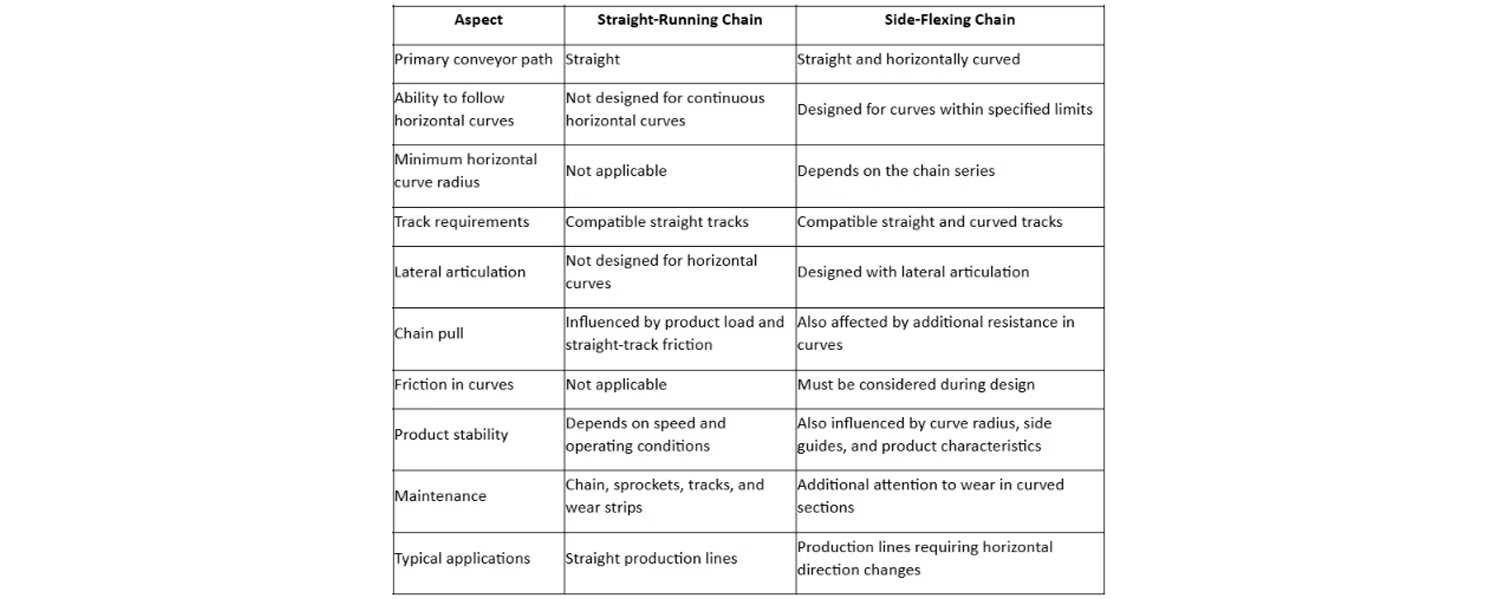
This comparison shows that both chain types serve different purposes. Side-flexing chains provide greater flexibility for curved layouts, but they are not automatically the better choice for every application.
When Should You Choose a Straight-Running Chain?
Straight-running chains are suitable when:
- The conveyor operates along a straight path.
- No horizontal curves are required within the continuous chain path.
- Production machines are arranged in a straight line.
- A straightforward track configuration meets the operating requirements.
- Product loads and transport capacity are within the chain's specifications.
For example, a packaging line may use a straight conveyor to transport bottles from a capping machine to a labeling machine. If the machines are aligned and no horizontal direction change is needed, a straight-running chain may be an appropriate solution.
When Should You Choose a Side-Flexing Chain?
Side-flexing chains should be considered when:
- The conveyor layout requires horizontal direction changes.
- Products must follow a continuous curved conveyor path.
- The available curve radius meets the chain manufacturer's specifications.
- Conveyor speed and product stability have been evaluated.
- Tracks, sprockets, and guides are compatible with the selected chain.
- Chain pull remains within permissible operating limits.
For example, a beverage production line may have filling, capping, and labeling machines arranged around the available factory space. If the conveyor must follow horizontal curves to connect these machines, a side-flexing chain can accommodate the required layout.
However, curve radius, chain pull, and bottle stability must be evaluated before finalizing the design.
Are Side-Flexing Chains Always Better?
No. The ability to follow horizontal curves is not required in every application.
If the conveyor only follows a straight path, a straight-running chain may provide the required functionality without introducing unnecessary design features. Conversely, using a straight-running chain where lateral articulation is required can result in mechanical incompatibility.
Therefore, chain selection should be based on layout requirements and operating conditions, rather than assuming that greater flexibility always means better performance.
7. Common Chain Selection Mistakes and Conclusion
Selecting an unsuitable chain can lead to operational problems, even in relatively simple conveyor systems. Several common mistakes should be avoided.
Common Mistakes When Selecting Table Top Chains
- Using straight-running chains on horizontal curves : Straight-running chains are not designed to follow continuous horizontal curves. Using them in unsuitable layouts may cause joint damage or irregular chain movement.
- Selecting side-flexing chains without checking minimum curve radius : Not all side-flexing chains can operate at the same radius. The selected radius must comply with the chain manufacturer's specifications and account for track geometry.
- Determining speed based only on straight sections : A conveyor speed that works well on a straight path may not provide the same product stability through curves.
- Ignoring product characteristics : Tall bottles, containers with narrow bases, and products with uneven weight distribution may behave differently in curved sections
- Overlooking chain pull : Curved sections can increase mechanical resistance, making it necessary to evaluate chain pull across the complete conveyor path.
- Using incompatible components : Sprockets, tracks, guides, and wear strips must be compatible with the selected chain series.
- Assuming side-flexing chains are always better : Side-flexing chains offer advantages for curved applications, but not every straight conveyor requires lateral flexibility.
Conclusion
The main difference between straight-running and side-flexing chains is their ability to follow different conveyor paths. Straight-running chains are designed for straight conveyor sections, while side-flexing chains can follow horizontal curves within specified operating limits.
However, chain selection should not be based solely on conveyor layout. For side-flexing conveyors, curve radius, speed, product stability, friction, and chain pull are critical factors that must be evaluated.
Products such as bottles and cans also require careful consideration of side guide positioning, center of gravity, and chain surface characteristics to maintain stability through curves. In addition, compatibility between the chain, track, sprockets, and wear strips is essential for reliable operation and manageable maintenance requirements.
The right chain is the one that matches the production layout, product characteristics, and conveyor operating requirements.
Understanding these differences helps engineering teams select appropriate table top conveyor configurations before finalizing system specifications.
Discuss Your Table Top Chain Conveyor Requirements with Connect Automation
Connect Automation provides table top chain conveyor solutions for transporting bottles, cans, and various packaged products in industrial production lines.
Selecting a conveyor requires consideration of layout configuration, product dimensions, production capacity, operating speed, and chain specifications.
Contact the Connect Automation team to discuss conveyor configurations that match your production requirements.
Explore Connect Automation's Conveyor Products and Solutions
Connect Automation specializes in providing automation solutions, including conveyor systems, to improve efficiency across various industries. The company delivers cutting-edge technology to help organizations automate tasks and optimize workflows. Connect Automation helps businesses reduce manual efforts, boost productivity, and achieve better outcomes. With a customer-focused approach, the company designs tailored solutions to ensure smooth and effective automation transitions for long-term success.
Kawasan Industri Jababeka Tahap 1, Jl. Jababeka II D Blok C14L Cikarang, Indonesia (17530)
(021) 893 5060 Google Maps
Rungkut Industri III, No. 37, Rungkut Menanggal, Kec. Gn. Anyar Surabaya, Indonesia (60293)
(031) 9985 8624 Google Maps