REQUEST A FREE ESTIMATE!
Simple Pneumatic Applications in Industrial Automation
In the era of smart factories, robotics, and digital control systems, pneumatic applications are often overlooked. They are sometimes seen as “basic,” “old-fashioned,” or merely a temporary solution before full automation.
In reality, simple pneumatic systems remain one of the most effective tools in industrial automation, especially when applied correctly and in the right context. For many processes, pneumatics are not a compromise, but the most practical and reliable solution.
Why Pneumatics Still Matter in Modern Industry
Pneumatic systems offer several inherent advantages:
- fast and repeatable motion
- simple mechanical design
- high reliability
- low cost compared to electric or robotic solutions
- safe operation in harsh or wet environments
Most importantly, pneumatics are very effective in stabilizing processes before more complex automation is implemented. This aligns with the principle of "earn the right to automate": simplify and stabilize processes before adding more complex technology.
Simple Pneumatics as a Foundation for Automation
Not every task requires a robot, servo, or complex control system. In fact, many automation problems originate from processes that were never stabilised in the first place. Simple pneumatic applications are often used to:
- position products consistently
- stop, separate, or release items
- clamp parts during operations
- reject defective products
- assist manual operations
These functions may look minor, but they often solve major sources of variation in production lines.
Common Simple Pneumatic Applications in Industry
1) Product Stopping and Positioning
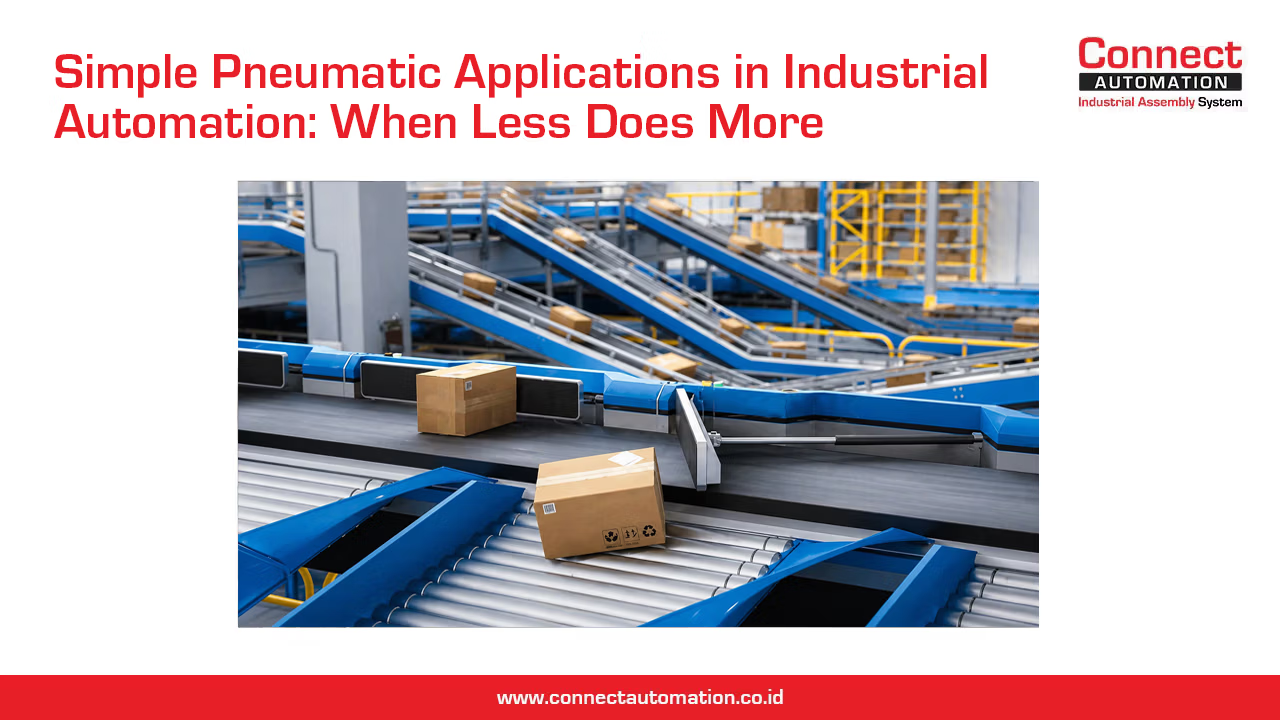
One of the most common pneumatic applications is the use of cylinders as stoppers. On conveyors or transfer lines, pneumatic stoppers:
- create consistent product spacing
- prevent product collisions
- enable accurate downstream operations
Without consistent positioning, sensors, PLC logic, and automation systems struggle to operate reliably.
2) Clamping and Holding During Processes
Pneumatic clamps are widely used in:
- assembly stations
- welding fixtures
- pressing and forming operations
Their role is simple: hold the part consistently in the correct position. This reduces rework, improves quality, and allows processes to be repeated reliably.
3) Sorting and Reject Mechanisms
Pneumatic pushers or diverters are frequently used for:
- quality rejects
- size or weight-based sorting
- routing products to different lines
Compared to complex systems, pneumatic reject mechanisms are:
- fast
- easy to maintain
- highly dependable
When combined with basic sensors and PLC control, they provide an effective first level of automation.
4) Manual Operation Assistance
In many production environments, full automation is not economical or necessary. Pneumatics are commonly used to:
- reduce operator fatigue
- assist lifting or pushing tasks
- ensure consistent force application
This improves ergonomics while maintaining flexibility—an often overlooked benefit.
Why Simple Pneumatics Often Outperform Complex Solutions
Complex automation introduces:
- more failure points
- higher maintenance requirements
- greater dependency on specialised skills
Simple pneumatic systems, when properly designed, offer:
- predictable behaviour
- fast response
- minimal programming complexity
- easier troubleshooting
In unstable processes, simplicity is a competitive advantage.
Design Considerations for Reliable Pneumatic Applications
Even simple pneumatic systems require proper design. Common issues arise not from the technology, but from poor implementation. Key considerations include:
- consistent air pressure and quality
- proper flow control for speed adjustment
- correct cylinder sizing
- use of guides or bearings to reduce side load
- clear operating sequence
Ignoring these fundamentals often leads to the false conclusion that “pneumatics are unreliable.”
Pneumatics and the “Earn the Right to Automate” Principle
Pneumatic applications are often the first step in automation maturity. They help:
- stabilise inputs
- standardise motion
- reduce human variation
- expose real bottlenecks
Once these fundamentals are in place, higher-level automation—such as PLC logic, servo systems, or robotics—can be introduced with far greater success. Skipping this step often results in over-engineered systems that struggle with basic consistency.
When Pneumatics Are the Right Long-Term Solution
It is a mistake to assume that pneumatics are always a temporary solution. In many cases, they are:
- the best solution for harsh environments
- ideal for simple, repetitive motions
- cost-effective for medium-volume production
- easier to maintain over long lifecycles
The goal of automation is not maximum sophistication, but maximum effectiveness.
Integrating Pneumatics with Control Systems
Simple pneumatic systems integrate naturally with:
- basic PLC control
- safety interlocks
- sensors and limit switches
This makes them excellent building blocks for scalable automation. A well-designed pneumatic application today can easily become part of a larger automated system tomorrow.
How Connect Automation Approaches Pneumatic Applications
At Connect Automation, pneumatic solutions are never treated as an afterthought. Our approach focuses on:
- understanding the process need
- selecting the simplest effective solution
- designing for reliability and maintenance
- ensuring compatibility with future automation
- integrating pneumatics logically with PLC and safety systems
The objective is not to add components—but to remove problems.
Conclusion
Simple pneumatic applications remain a powerful tool in industrial automation. When applied correctly, they:
- stabilise processes
- reduce variation
- improve safety and ergonomics
- support future automation
In many cases, doing less—but doing it right—delivers more value.
Connect Automation specializes in providing automation solutions, including conveyor systems, to improve efficiency across various industries. The company delivers cutting-edge technology to help organizations automate tasks and optimize workflows. Connect Automation helps businesses reduce manual efforts, boost productivity, and achieve better outcomes. With a customer-focused approach, the company designs tailored solutions to ensure smooth and effective automation transitions for long-term success.
Kawasan Industri Jababeka Tahap 1, Jl. Jababeka II D Blok C14L Cikarang, Indonesia (17530)
(021) 893 5060 Google Maps
Rungkut Industri III, No. 37, Rungkut Menanggal, Kec. Gn. Anyar Surabaya, Indonesia (60293)
(031) 9985 8624 Google Maps