REQUEST A FREE ESTIMATE!
Open Frame vs Closed Frame Conveyors for Food Processing Industry
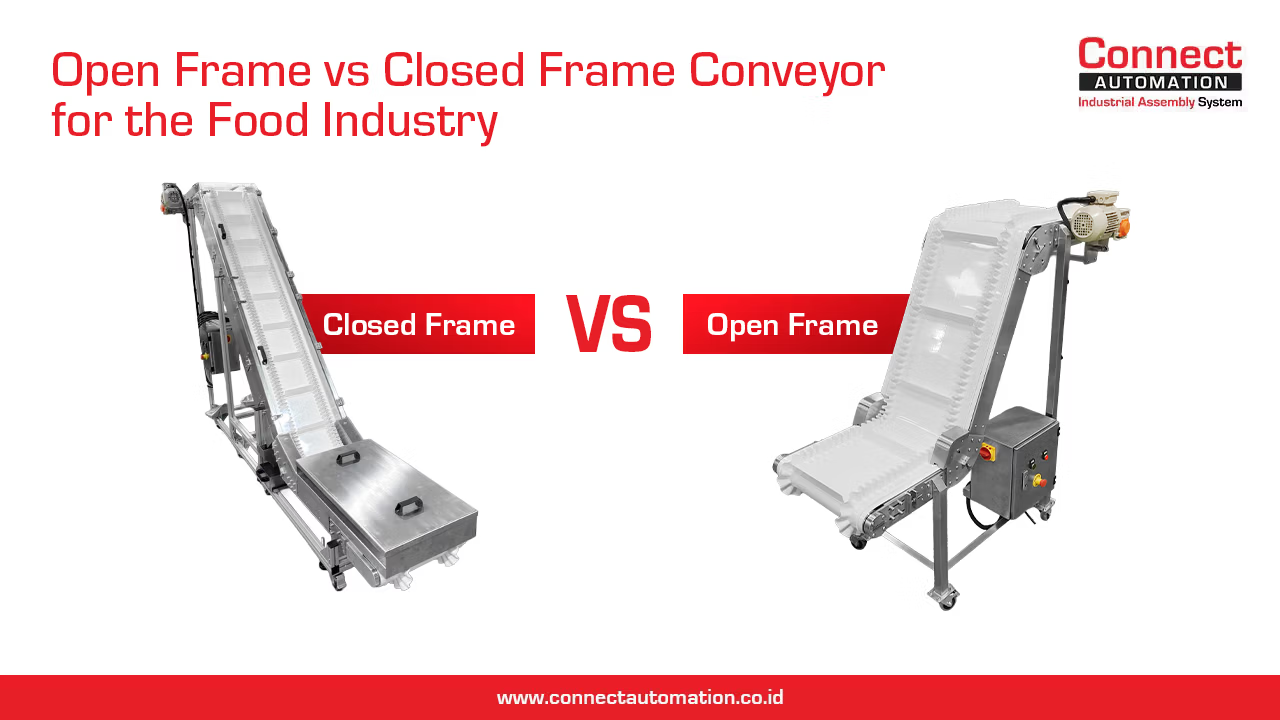
In the food processing industry, conveyor hygiene is not determined solely by the type of belt that comes into direct contact with food products. The conveyor frame also plays an important role, as its design can influence residue accumulation, water pooling, and the overall ease of cleaning.
One important consideration when designing conveyors for food processing applications is choosing between open frame and closed frame conveyor designs. Both configurations have different characteristics, particularly in terms of cleaning accessibility, drainage, and component inspection.
In production environments that require frequent washdowns, an unsuitable frame design can create hidden areas that are difficult to clean. These conditions may increase cleaning time and make it harder to verify whether the conveyor has been properly sanitized.
So, what are the differences between open frame and closed frame conveyors? Is an open frame always more hygienic? And under what conditions can a closed frame conveyor be used in food processing facilities?
Why Is Conveyor Frame Design Important for Hygiene?
The conveyor frame is the main structural component that supports the belt, rollers, motor, and other conveyor components. In food processing environments, the frame may be exposed to washdown water, product splashes, oils, and residues generated during production. Although the frame may not come into direct contact with food, its condition still requires attention because accumulated contamination can become a source of indirect food contamination.
For example, on a conveyor used to transport wet food products, liquids and food particles may enter the area beneath the belt or accumulate around frame joints. If these areas are difficult to access, cleaning becomes more complicated. Several potential issues should be considered:
- Water pooling: Horizontal surfaces or certain cavities may retain water after cleaning.
- Residue accumulation: Frame joints, gaps, and concealed areas may collect food particles and other contaminants.
- Limited cleaning access: Closely positioned or enclosed components may make cleaning more difficult.
- Inspection challenges: Hidden areas can make it harder to verify cleanliness after sanitation.
For these reasons, conveyor frame construction should be evaluated for cleaning accessibility and inspection requirements during the design stage. This approach is consistent with the principles of hygienic design, which focus on reducing contamination risks and making equipment easier to clean.
For more information about conveyor applications involving high-moisture products, read our article on Hygienic Modular Conveyors for Wet Food Processing.
What Is the Difference Between Open Frame and Closed Frame Conveyors?
The main difference between these designs lies in how the supporting structure is constructed and how easily internal conveyor areas can be accessed.
Open Frame Conveyors
An open frame conveyor features an exposed supporting structure that allows relatively easy visibility and access to internal conveyor components. Depending on the design, areas around the belt, rollers, and underside of the conveyor can be accessed for cleaning and inspection.
Common characteristics of open frame conveyors include:
- An open structure that supports visual inspection.
- Easier access to internal conveyor areas.
- Improved visibility of residue around mechanical components.
- Better accessibility for cleaning operations.
- The ability to inspect certain components without removing multiple covers or panels.
Open frame construction can be suitable for food processing environments that require frequent washdowns and routine hygiene inspections. However, an open frame does not automatically make a conveyor hygienic. Poorly designed joints, gaps, or horizontal surfaces may still trap water and food residues.
Closed Frame Conveyors
A closed frame conveyor uses enclosed structural sections or protective panels that prevent some internal components from being directly visible. This type of construction may be used to protect certain components from environmental exposure or to meet specific mechanical design requirements.
Common characteristics of closed frame conveyors include:
- Some structural components are enclosed by frames or protective panels.
- Additional protection may be provided against direct environmental exposure.
- Cleaning accessibility depends on panel design and structural joints.
- Internal inspection may require removing covers or opening access panels.
- Particular attention is required to prevent liquids and residues from entering enclosed cavities.
Closed frame conveyors are not necessarily more difficult to clean. An enclosed structure with cleanable surfaces, appropriate sealing, and adequate inspection access can still be suitable for certain food processing applications.
The key consideration is ensuring that the design does not create inaccessible areas where liquids, food particles, or other contaminants can accumulate.
How Frame Design Affects Water Pooling, Residue Accumulation, and Cleaning
One of the most important factors when choosing between open frame and closed frame conveyors is how the structure affects cleaning and sanitation procedures.
1. Water Pooling After Washdown
In wet food processing environments, conveyors are often cleaned using water and cleaning agents according to the facility's sanitation procedures. Washdown water can collect on flat frame surfaces, around joints, or inside cavities that do not have adequate drainage.
This condition requires attention because retained moisture can delay drying and increase the risk of microbial growth if not properly controlled. On open frame conveyors, exposed structural components can make it easier to identify areas where water accumulates. However, effective drainage still depends on the shape and orientation of the frame profiles.
The same principle applies to closed frame conveyors. An enclosed structure with appropriately sloped surfaces may allow water to drain effectively. However, poorly sealed cavities or joints may allow liquids to enter and remain trapped.
Therefore, the evaluation should not focus only on whether the frame is open or closed. Important considerations include:
- The slope of surfaces exposed to washdown water.
- Drainage paths that allow liquids to escape.
- The condition of joints between structural components.
- The presence of cavities that may retain water.
- Accessibility for post-cleaning inspection.
A well-designed conveyor frame should minimize water-retaining areas while supporting effective drainage and drying.
2. Residue Accumulation Around Frame Joints
In addition to water, food particles and processing residues may accumulate on conveyor structures. Examples include meat particles, oils, flour, seasoning residues, and liquids released during production.
These materials can collect in narrow gaps, bolted connections, and areas where structural components meet. On open frame conveyors, such areas may be easier to identify when sufficient inspection access is provided.
On closed frame conveyors, poorly sealed panel joints or concealed cavities may require additional attention during cleaning and inspection. To reduce these risks, conveyor design should consider joint geometry, accessibility, and whether certain components need to be removable for effective cleaning.
3. Impact on Cleaning Time
Cleaning accessibility is one factor that influences the time required to clean a conveyor. In designs that use multiple protective panels, operators may need to remove or open certain sections before reaching internal components.
By comparison, an open frame structure may reduce the need to remove covers because more components are directly accessible. However, cleaning time is not determined by frame construction alone.
Belt type, roller arrangement, drive system positioning, and sanitation procedures can also affect the cleaning process. For this reason, the main benefit of accessible construction is not simply faster cleaning.
It is the ability to clean and inspect relevant surfaces more thoroughly and consistently.
In facilities with routine sanitation schedules, improved accessibility may also help reduce preparation and inspection time before equipment is returned to service.
Conveyor Legs, Structural Joints, and Underside Design
In addition to the main frame, conveyor leg construction is an important consideration when designing equipment for food processing environments.
The underside of a conveyor may be exposed to washdown water, product splashes, and materials that fall from the production line.
If conveyor legs contain narrow gaps or inaccessible areas, cleaning the surrounding floor and supporting structure may become more difficult.
Conveyor Leg Design
Conveyor legs should be designed with consideration for cleaning accessibility around both the supports and their contact points with the floor. Important aspects include:
- Floor contact areas: Avoid configurations that create narrow spaces that are difficult to clean.
- Adjustable feet: Consider exposed threads, joints, and potential residue accumulation points.
- Base plates: Ensure the design and installation do not create areas where water can accumulate.
- Underside clearance: Provide sufficient access for cleaning and inspection according to facility requirements.
- Structural profiles: Evaluate whether liquids can enter and become trapped inside hollow sections.
Hollow structural profiles or enclosed supports are not automatically unsuitable for hygienic applications. However, their ends and joints must be designed to prevent liquids from entering and accumulating inside the structure.
Structural Joints and Cavities
Frame joints also have a significant impact on cleanability. Narrow gaps that cannot be accessed may make it difficult to remove accumulated residues.
For this reason, joints should either be accessible for cleaning or appropriately sealed according to the application requirements. For welded structures, weld quality and surface finishing should be considered to avoid cracks, crevices, and rough surfaces that may retain contaminants.
Bolted connections and removable components should also be evaluated for cleaning accessibility and potential residue accumulation. These considerations demonstrate that using stainless steel alone does not guarantee a hygienic conveyor.
Structural design, joint quality, and cleaning accessibility are equally important.
For further information about conveyor frame materials, explore our articles on Connect Automation's Industrial Conveyor Blog, including the comparison between stainless steel 201 and stainless steel 304.
Open Frame vs Closed Frame Conveyor Comparison
The following table compares both frame configurations based on factors relevant to food processing environments.
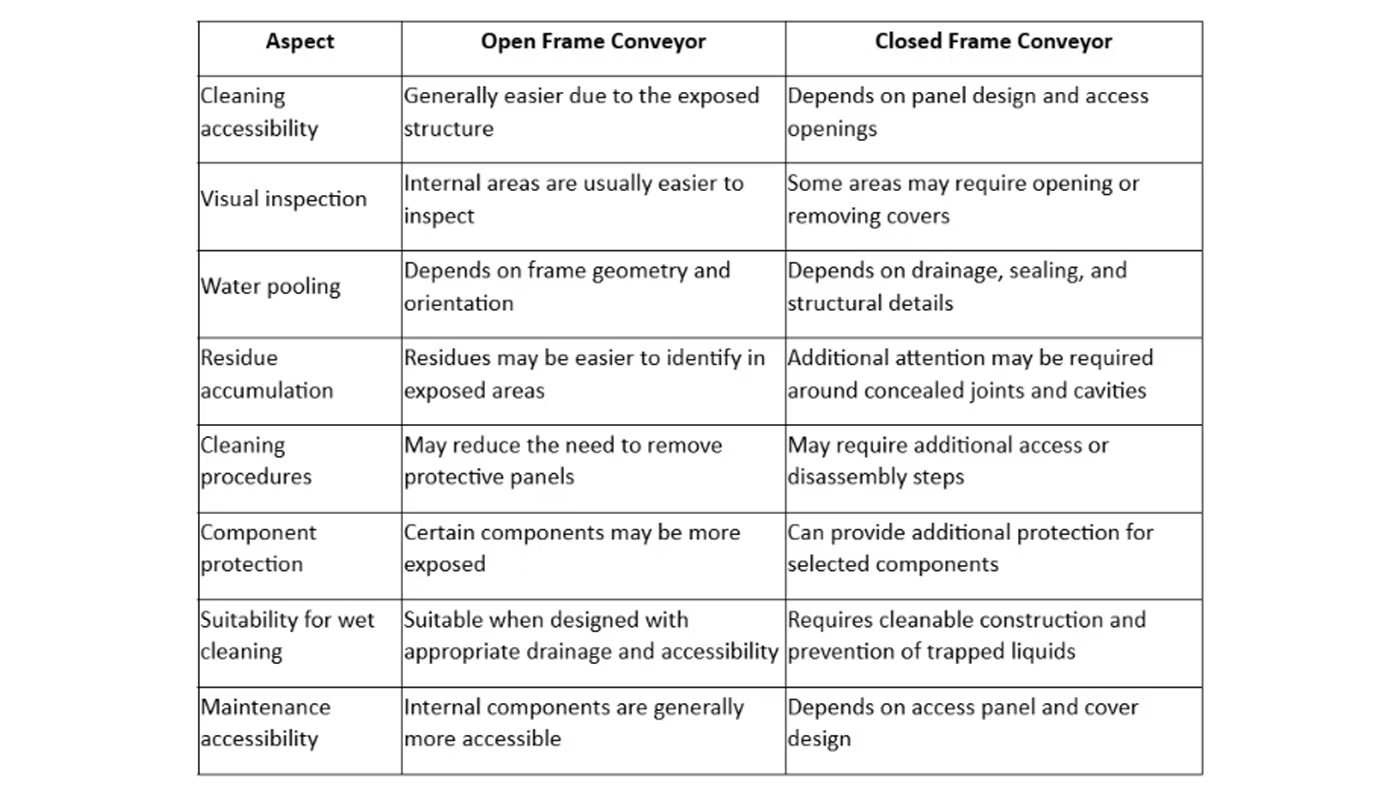
This comparison shows that open frame conveyors often provide advantages in terms of cleaning accessibility and visual inspection.
However, the hygienic performance of a conveyor cannot be determined solely by whether its frame is open or closed. Construction details, product characteristics, and sanitation procedures are equally important.
When Should You Choose an Open Frame or Closed Frame Conveyor?
Frame selection should be based on the production environment, contamination risks, and cleaning requirements.
When Is an Open Frame Conveyor More Suitable?
Open frame construction is often advantageous for applications that require frequent cleaning and detailed inspection. Examples include:
- Production areas with routine wet cleaning In facilities where conveyors are regularly washed with water, an open structure can provide better access to internal components.
- Processes that generate significant product residues Operations involving food particles, oils, or liquids benefit from construction that allows accumulated residues to be identified and removed.
- Conveyors requiring frequent hygiene inspections An open frame can make it easier to inspect areas beneath the belt and around rollers and other components.
- Production areas requiring cleaning access from multiple sides In certain applications, exposed construction allows cleaning personnel to reach areas that may not be accessible from only one side of the conveyor.
For example, conveyors used in meat, fish, and seafood processing may benefit from frame designs that provide improved access for washing and inspection. However, the final selection should still consider the conveyor's position within the production process, product characteristics, and facility sanitation requirements.
When Can a Closed Frame Conveyor Be Used?
Closed frame conveyors may remain suitable for certain applications when their construction meets operational and hygiene requirements. Several situations may be considered.
- Areas with relatively low residue exposure In operations involving already-packaged products or areas with lower contamination risks, an enclosed structure may be suitable depending on the production environment.
- Applications requiring component protection Protective panels can help shield selected components from direct exposure, provided they do not introduce inaccessible cavities or difficult-to-clean gaps.
- Enclosed structures designed for hygiene Closed frames with cleanable surfaces, appropriate joints, and adequate inspection access can support sanitation requirements.
- Production areas using dry cleaning methods In some dry food processing operations, cleaning methods that avoid introducing water may be more appropriate.
Frame design should support the removal of dry residues without creating areas where dust or product particles can accumulate.
Therefore, closed frame construction should not automatically be considered unsuitable for food processing. Its suitability depends on contamination risks, cleaning methods, and the ability of the structure to support effective sanitation.
Checklist for Selecting Conveyor Frame Designs in Food Processing
Before selecting an open frame or closed frame conveyor, engineering and production teams can use the following questions as an initial evaluation checklist.
- Does the product come into direct contact with the conveyor? Direct food contact applications require careful consideration of contamination risks from surrounding components.
- Is the conveyor cleaned using water? Wet cleaning requires appropriate drainage, structural sealing, and the ability to dry equipment after washing.
- Does the production process generate liquids or food residues? The greater the potential for residue accumulation, the more important cleaning accessibility and inspection become.
- Can all relevant frame areas be inspected? Ensure that internal areas, structural joints, and the conveyor underside can be examined without leaving inaccessible locations.
- Are there surfaces where water may accumulate? Inspect horizontal surfaces, structural profiles, joints, and drainage paths.
- Does the leg design allow effective floor cleaning? Areas surrounding conveyor supports should provide sufficient access to remove accumulated residues and water.
- Do components need to be removed during cleaning? Consider the number of covers or components that must be removed and the time required for post-cleaning inspection.
- Are the materials and structural details suitable for the production environment? Material selection should account for corrosion resistance, cleaning chemicals, and operating conditions.
This checklist can help identify initial requirements before finalizing conveyor specifications. However, applications with demanding hygiene requirements should also be evaluated through appropriate risk assessments, sanitation requirements, and a comprehensive review of the equipment design.
Conclusion
Choosing between open frame and closed frame conveyors affects cleaning accessibility, inspection procedures, and residue control in food processing environments. Open frame conveyors generally offer advantages in accessing internal components, making them a suitable option for applications involving frequent washdowns and significant residue exposure.
Meanwhile, closed frame conveyors can remain suitable when their construction prevents contaminants from entering inaccessible areas, supports appropriate drainage, and provides adequate cleaning access.
Ultimately, a hygienic conveyor is not defined simply by whether its frame is open or closed, but by how effectively its entire construction supports cleaning and contamination prevention. Selecting the right frame requires consideration of product characteristics, production conditions, sanitation procedures, and operational requirements.
Consult Connect Automation for Your Conveyor Requirements
Connect Automation provides industrial conveyor solutions for a wide range of production and material handling applications.
Selecting the appropriate conveyor involves more than choosing a belt type or determining production capacity. Frame construction, materials, and maintenance accessibility should also be evaluated according to the operating environment.
Contact the Connect Automation team to discuss conveyor specifications that match your production requirements.
Explore Connect Automation's Conveyor Products and Solutions
Connect Automation specializes in providing automation solutions, including conveyor systems, to improve efficiency across various industries. The company delivers cutting-edge technology to help organizations automate tasks and optimize workflows. Connect Automation helps businesses reduce manual efforts, boost productivity, and achieve better outcomes. With a customer-focused approach, the company designs tailored solutions to ensure smooth and effective automation transitions for long-term success.
Kawasan Industri Jababeka Tahap 1, Jl. Jababeka II D Blok C14L Cikarang, Indonesia (17530)
(021) 893 5060 Google Maps
Rungkut Industri III, No. 37, Rungkut Menanggal, Kec. Gn. Anyar Surabaya, Indonesia (60293)
(031) 9985 8624 Google Maps