
REQUEST A FREE ESTIMATE!
Lean Manufacturing The Role of Karakuri in Production Systems
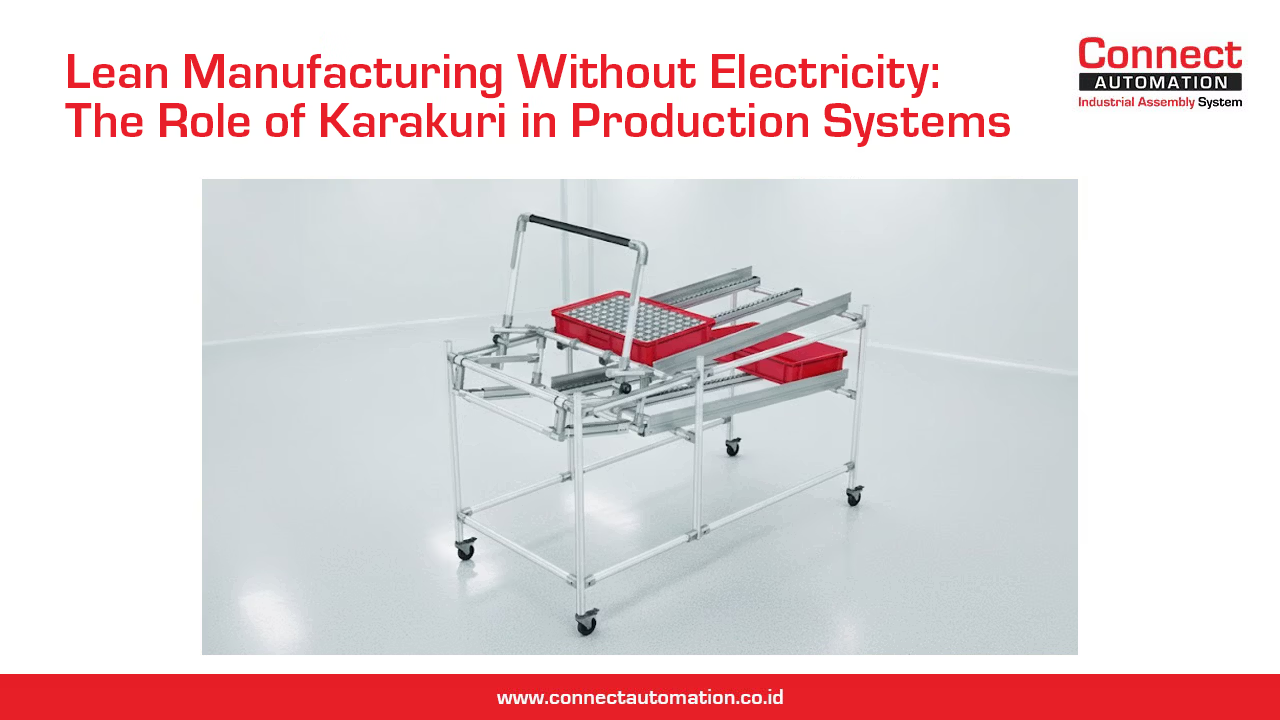
Lean Manufacturing Without Electricity: The Role of Karakuri in Production Systems
In the pursuit of higher productivity, many production systems are often associated with adding machines and automation. In practice, however, the more machines are introduced, the higher the operational costs become—ranging from electricity consumption and maintenance requirements to hidden downtime risks. This is where karakuri offers a different approach. Not as a replacement for technology, but as part of lean manufacturing, focusing on improving the work system first before accelerating processes through automation.
What Is Karakuri?
Karakuri is a mechanical system designed to support production workflows without using electricity. It relies on simple principles such as gravity, balance, levers, and mechanical linkages to move, position, or flow materials. In manufacturing environments—particularly in Japan—karakuri is widely used to:
- Maintain clear and consistent material flow
- Support manual work to be more efficient
- Reduce dependency on machines and electrical systems
Karakuri is not about speed; it is about getting the flow right.
Why Lean Manufacturing Does Not Always Require Electricity
The goal of lean manufacturing is to eliminate waste, not to add complexity. In many cases, waste actually comes from:
- Systems that are overly dependent on machines
- Processes that stop due to electrical or sensor-related issues
- Maintenance activities that consume time and cost
With its non-electric design, karakuri offers:
- Operational stability independent of power supply
- More predictable operating costs
- Lower risk of unplanned downtime
For factory owners and production managers, this means systems that are easier to control and more reliable on a daily basis.
The Role of Karakuri in Production Systems
Karakuri is typically applied in areas that still involve direct human interaction, such as:
- Material storage and retrieval (FIFO systems)
- Feeding materials to assembly lines
- Buffers between processes
- Manual workstations with high repetition
With proper design, karakuri helps ensure that:
- Materials are always positioned correctly
- Work sequences remain consistent
- Operators avoid unnecessary movements
The result is not only higher efficiency, but also more stable product quality.
Karakuri Is Designed to Support People, Not Replace Them
Unlike full automation, karakuri keeps humans as a central part of the production system. Its purpose is to make manual work:
- Safer
- More ergonomic
- More consistent in product handling
By using simple mechanical systems, risks related to fatigue, poor working posture, and inconsistent handling can be significantly reduced.
Karakuri Design and Material Considerations
In practice, karakuri systems can be built using various structural materials, such as square profiles, stainless steel, or channel steel, depending on load requirements, working environment, and product characteristics. One option commonly used in areas with frequent manual interaction is profile tube. Its rounded shape helps minimize sharp edges, which:
- Reduces the risk of hands or other body parts being scratched during operation
- Improves safety in manual work areas
- Supports ergonomic and occupational safety considerations
Material selection in karakuri is not about choosing the strongest option, but about selecting the most appropriate solution for the function, risk level, and operational conditions.
Karakuri as a Foundation Before Automation
Karakuri is often implemented as an initial step to ensure that:
- The workflow is correct
- FIFO logic is properly applied
- The production layout makes practical sense
In other words, karakuri helps validate the production system. Once a process is stable and proven to work manually, automation can then be introduced with greater confidence and accuracy. Automation accelerates a system. Karakuri ensures that what is being accelerated is the right system.
Conclusion
Karakuri is more than just a rack or a mechanism without electricity. It represents a lean way of thinking—prioritizing system stability, safety, and correctness before pursuing speed. Within a well-designed production system, karakuri serves as a practical solution to improve efficiency, maintain quality, and help people work more safely and consistently, without always relying on machines and electrical power.
Connect Automation specializes in providing automation solutions, including conveyor systems, to improve efficiency across various industries. The company delivers cutting-edge technology to help organizations automate tasks and optimize workflows. Connect Automation helps businesses reduce manual efforts, boost productivity, and achieve better outcomes. With a customer-focused approach, the company designs tailored solutions to ensure smooth and effective automation transitions for long-term success.
Kawasan Industri Jababeka Tahap 1, Jl. Jababeka II D Blok C14L Cikarang, Indonesia (17530)
(021) 893 5060 Google Maps
Rungkut Industri III, No. 37, Rungkut Menanggal, Kec. Gn. Anyar Surabaya, Indonesia (60293)
(031) 9985 8624 Google Maps