REQUEST A FREE ESTIMATE!
Flat Top vs Flush Grid vs Raised Rib Modular Conveyor Surface
In industrial material handling systems, modular belt conveyors are widely used to transport bottles, food packages, trays, containers, and various manufactured products. In addition to their construction from interconnected plastic modules, modular belts are available with different surface designs to accommodate specific product handling requirements.
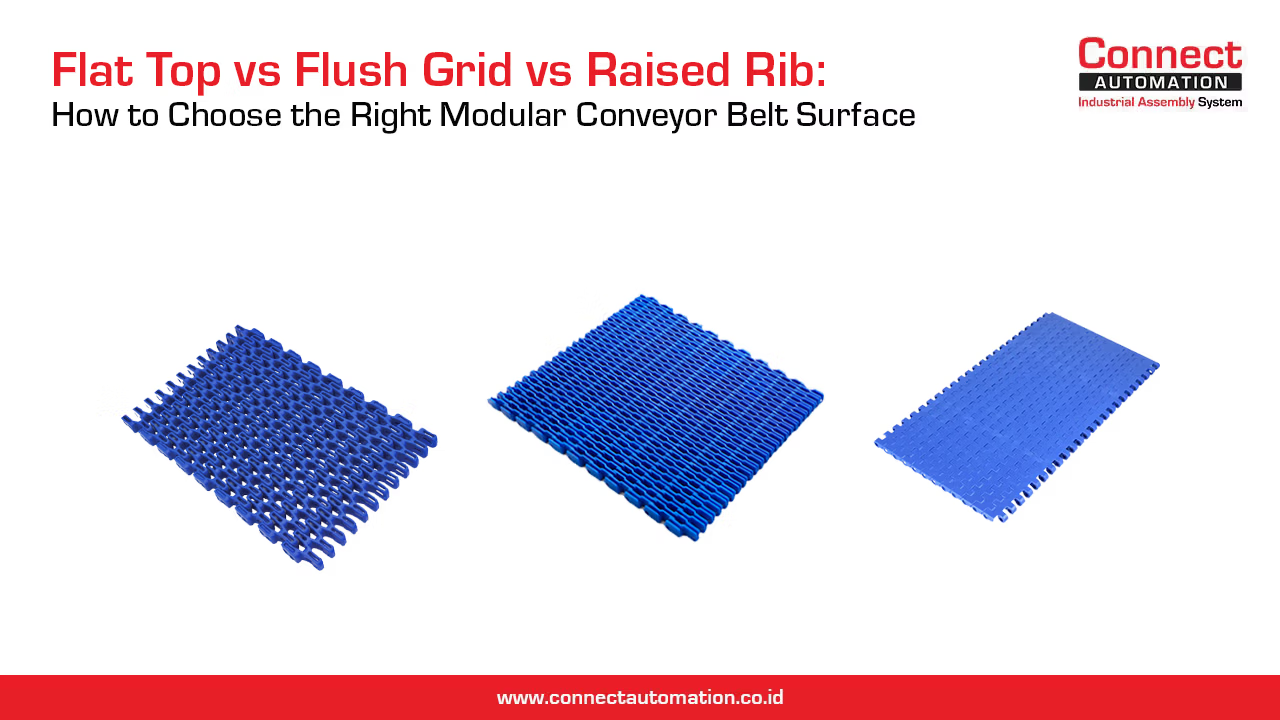
Three commonly used modular belt surface types are flat top, flush grid, and raised rib.
Although all three can be used in modular conveyor systems, their different surface geometries can affect product stability, drainage, airflow, and product transfer between conveyors.
For example, products with small bases may require a relatively continuous surface to provide adequate support. In contrast, products passing through washing processes may benefit from an open belt surface that allows water to drain through.
Meanwhile, certain raised rib modular belt designs are compatible with finger transfer plates, which can help support products as they move from one conveyor section to another.
So, what are the differences between flat top, flush grid, and raised rib modular belts? How can engineers select the most suitable surface for their production requirements?
1. Why Is Modular Belt Surface Selection Important?
Selecting a modular belt involves more than choosing its material, width, or load capacity. The belt's surface geometry also influences how products are supported and transported. For conveyors handling bottles or containers with relatively small bases, a flat conveying surface can help maintain product stability.
However, in processes involving water, liquids, or airflow requirements, an open modular belt surface may be more appropriate. Several factors should be considered when selecting a modular belt surface:
- Product characteristics: Shape, dimensions, weight, and surface condition.
- Product stability: The ability of the belt surface to provide adequate support during transportation.
- Drainage requirements: Whether liquids need to pass through the conveying surface.
- Airflow: Whether air circulation through the belt is required.
- Cleaning procedures: Accessibility for cleaning belt surfaces and module joints.
- Product transfer: How products move from the conveyor to downstream equipment.
- Operating conditions: Conveyor speed, temperature, and production environment.
For example, a modular conveyor transporting dry plastic containers may not require an open belt surface. In contrast, a conveyor handling products immediately after a washing process may benefit from a surface that allows water to drain through.
This demonstrates that modular belt surface selection should be based on process requirements rather than simply the industry or product material.
2. Differences Between Flat Top, Flush Grid, and Raised Rib Modular Belts
Each modular belt surface type has distinct structural characteristics designed to support different product handling requirements.
Flat Top Modular Belts
A flat top modular belt features a relatively smooth, closed conveying surface that provides continuous support for transported products. This design can help maintain the stability of products with flat or relatively small bases.
Common characteristics of flat top modular belts include:
- A relatively flat and closed top surface.
- Continuous support across much of the conveying surface.
- No large drainage openings through the belt surface.
- Suitability for products with flat bases.
- Compatibility with applications requiring a relatively even conveying surface.
Examples of products that may be transported using flat top modular belts include:
- Plastic bottles.
- Containers and jars.
- Packaging cartons.
- Plastic trays.
- Rigid products with flat bases.
In filling and packaging lines, flat top surfaces can help support products as they move between production processes. However, using a flat top belt does not automatically guarantee product stability.
Product dimensions, center of gravity, conveyor speed, and transfer conditions must still be considered. In addition, although the top surface is relatively closed, the joints between individual modules still require attention during cleaning.
Flush Grid Modular Belts
A flush grid modular belt features a surface with openings that allow water and air to pass through the belt. Unlike flat top designs, flush grid belts have an open surface structure.
The percentage of open area and the dimensions of the openings depend on the specific belt series and manufacturer. Common characteristics of flush grid modular belts include:
- Openings distributed across the conveying surface.
- The ability to allow water to drain through the belt.
- Support for airflow in certain applications.
- Suitability for washing, rinsing, draining, and cooling processes.
- The need to match opening dimensions with product characteristics.
Potential applications include:
- Products transported after washing.
- Wet plastic crates and trays.
- Food products undergoing draining processes.
- Cooling or drying processes requiring airflow.
- Production applications involving liquids.
For example, plastic trays leaving a washing process may still carry water on their surfaces. A flush grid modular belt allows some of this water to pass through the belt as the products move toward the next process.
However, flush grid belts are not automatically the best choice for every wet product. Small, soft, or flexible products may require additional evaluation because parts of the product could enter or become caught in the belt openings. Opening dimensions and patterns must be evaluated to ensure sufficient product support.
Raised Rib Modular Belts
A raised rib modular belt features a conveying surface with elevated ribs that create specific product contact areas. Unlike a flat top surface, which provides relatively continuous support, raised rib belts primarily support products through the raised sections. Some raised rib designs also incorporate open spaces between the ribs.
Common characteristics include:
- A conveying surface with raised ribs.
- A different product contact pattern compared with flat top belts.
- The potential to reduce direct contact area between products and the belt.
- Airflow or liquid drainage characteristics depending on the belt design.
- Compatibility with finger transfer plates on certain belt series.
One important application of raised rib modular belts involves product transfer at the end of a conveyor. On compatible belt series, finger transfer plates can extend into the spaces between the ribs, helping support products as they transition away from the moving belt.
However, not all raised rib modular belts are designed for finger transfer plates. Compatibility must be verified using the manufacturer's technical specifications. It is also important to distinguish raised rib belts from friction top belts and cleated belts.
Friction top belts are designed to provide additional grip in certain applications, while cleated belts use raised cleats to help retain products. Raised rib belts have their own surface characteristics and do not automatically provide increased grip or product retention on inclined conveyors.
3. How Modular Belt Surfaces Affect Product Stability
One of the main considerations when selecting a modular belt surface is its ability to support products during transportation. Different product shapes require different levels of surface contact and support.
Product Contact Area
The contact area between a product and the modular belt influences load distribution and stability.
Flat top belts provide a relatively continuous supporting surface, which can distribute loads more evenly for products with flat bases.
Flush grid belts contain openings that reduce the available direct contact area.
Raised rib belts primarily support products through the elevated ribs.
These differences are particularly important for products with:
- Small supporting bases.
- Uneven bottom surfaces.
- Soft or flexible materials.
- Weight concentrated in specific areas.
- A tendency to shift or tip during movement.
For example, a bottle with a small base diameter may require sufficient supporting surface area to maintain its upright position. If the bottle is placed on a belt with openings or rib spacing that is too large, part of its base may lack adequate support.
Conversely, a large rigid product may perform well on an open belt surface, provided that the belt's load capacity and support geometry are appropriate.
Soft and Irregularly Shaped Products
Soft or flexible products require additional consideration. For example, unpackaged food products may have irregular shapes and can deform while resting on a conveyor. In these applications, modular belt surface geometry can affect how the product is supported.
Flush grid belts with certain opening patterns may be unsuitable if parts of the product can enter the openings. Raised rib belts must also be evaluated because contact through the ribs creates a different pressure distribution compared with flat top surfaces.
Therefore, choosing a belt for soft products should not be based solely on drainage requirements. Product characteristics and the possibility of deformation during transportation must also be evaluated.
The Effect of Conveyor Speed
Product stability is not determined by belt surface design alone. Conveyor speed and changes in speed also play important roles.
Products may shift when:
- The conveyor starts moving.
- The conveyor stops.
- Products pass through transfer points.
- Two conveyor sections operate at different speeds.
- Products change direction.
The selected modular belt surface must therefore be considered together with the overall conveyor configuration. A surface that provides adequate support when stationary may not provide the same level of stability during acceleration or product transfer.
For examples of modular belt applications involving bottles, containers, and trays, read our article on Modular Conveyors for Various Plastic Products.
4. Drainage, Airflow, and Cleaning Requirements
In addition to product stability, modular belt surface design affects how liquids, air, and residues move during production. These characteristics are especially important in wet processing environments or applications requiring temperature control.
Selecting a Modular Belt for Drainage
In washing processes and wet production environments, products may carry water or other liquids along the conveyor. If the process requires liquid to pass through the conveying surface, flush grid belts can be considered because their openings allow water to drain downward.
For example, products leaving a rinsing process may be transported on a flush grid modular conveyor toward the next production stage. However, drainage performance depends on several factors:
- Percentage of open belt area.
- Size and shape of surface openings.
- Liquid characteristics.
- Amount of liquid carried by the products.
- Product position on the belt.
- Drainage collection design beneath the conveyor.
Therefore, a larger open area does not necessarily provide the best solution for every application. The size of the openings must remain compatible with the product's geometry and supporting requirements.
For more information about wet processing applications, read Hygienic Modular Conveyors for Wet Food Processing.
How Belt Surface Design Affects Airflow
Some production processes require air to circulate around products to support cooling or drying. Flush grid modular belts can support these processes because their openings allow air to pass through the conveying surface.
This characteristic may be useful in certain cooling and drying conveyor systems. However, cooling performance is not determined solely by the percentage of open belt area.
Other important factors include:
- Air temperature.
- Air velocity.
- Product residence time on the conveyor.
- Product shape and arrangement.
- Exposed product surface area.
- Airflow distribution throughout the system.
Raised rib belts may also provide spaces between the ribs that support specific airflow characteristics, depending on their construction. Therefore, belt surface selection should be coordinated with the overall cooling or drying process design.
Are Flat Top Belts Easier to Clean?
A relatively closed flat top surface may provide a simpler upper surface for cleaning in certain applications. However, this does not mean that flat top belts are always more hygienic than flush grid or raised rib belts.
Modular belts consist of individual interconnected modules joined through hinge mechanisms. These joints require attention because residues may accumulate in areas that are difficult to access. On flush grid belts, surface openings can support drainage but may also trap certain types of particles.
On raised rib belts, the spaces between ribs must be accessible for effective cleaning. Cleanability should therefore be evaluated based on:
- Belt surface design.
- Hinge geometry.
- Access to the underside of the belt.
- Types of residues generated during production.
- Cleaning methods used by the facility.
- Material compatibility with cleaning chemicals.
An open modular belt surface is not automatically more hygienic, and a closed surface is not automatically easier to clean. The appropriate choice depends on how effectively the belt design supports the facility's sanitation procedures.
5. How Modular Belt Surfaces Affect Product Transfer
In addition to transporting products along the conveyor, the transfer process at the conveyor's discharge end is an important consideration when selecting modular belts. Product transfer occurs when items move from one conveyor to another or enter downstream production equipment.
At these locations, products must pass through a transition area that may include gaps between conveying surfaces. If the gap is too large relative to the product dimensions, the transfer may become unstable.
Why Are Transfer Points Important?
Products with wide, stable bases generally behave differently during transfers compared with small or short products. For example, a large plastic crate may maintain sufficient support while part of its base crosses a transfer gap.
In contrast, a small product may lose support when the gap between conveyor surfaces is too large. Important parameters include:
- Product length in the direction of travel.
- Supporting base area and geometry.
- Product weight.
- Center of gravity.
- Transfer gap dimensions.
- Conveyor speed.
- Height differences between conveying surfaces.
For these reasons, belt surface selection should consider the intended product transfer arrangement.
Product Transfer Using Nosebars
Some modular conveyor systems use nosebars to reduce the transition gap at the conveyor discharge. However, not all modular belts are compatible with the same nosebar radius.
The ability of a modular belt to travel around a small radius depends on its pitch, module geometry, and hinge construction. Nosebar applications must comply with the belt manufacturer's design requirements and technical specifications.
Raised Rib Belts and Finger Transfer Plates
One notable characteristic of certain raised rib modular belts is their compatibility with finger transfer plates. Finger transfer plates use narrow, finger-like extensions that fit between the raised ribs on the belt surface.
This configuration can help support products as they leave the moving modular belt. As a result, products may transition across the transfer area with more controlled support in suitable applications.
However, several factors must be considered:
- Raised rib geometry must be compatible with the finger transfer plate.
- Finger plate position and clearance must follow manufacturer specifications.
- Product shape and dimensions must suit the transfer arrangement.
- The finger plate must not interfere with belt movement.
- The design must account for potential product jamming or misalignment.
Not all raised rib modular belts are compatible with finger transfer plates.
Furthermore, finger transfer plates are not universal solutions for every small product or transfer configuration. Raised rib selection for transfer applications must therefore be based on verified component compatibility and actual product characteristics.
6. Flat Top vs Flush Grid vs Raised Rib: Comparison and Selection Guide
After understanding the characteristics of each surface type, the following comparison can help guide initial belt selection.
Modular Belt Surface Comparison

This table provides a general comparison. Actual characteristics may vary between manufacturers and modular belt series.
When Should You Choose Flat Top Modular Belts?
Flat top belts may be suitable when:
- Products require relatively uniform surface support.
- Products have small bases or require a continuous supporting surface.
- Direct drainage through the belt is unnecessary.
- Products are transported under relatively dry conditions.
- A flat conveying surface is preferred.
For example, flat top belts can transport bottles, containers, and rigid packages in production lines. However, final selection must still account for product dimensions, weight, and stability.
When Should You Choose Flush Grid Modular Belts?
Flush grid belts may be suitable when:
- The production process involves water or other liquids.
- Products pass through washing or rinsing operations.
- Liquids need to drain through the conveying surface.
- Airflow through the belt is required.
- Product dimensions are compatible with the opening pattern.
For example, flush grid belts can transport trays or containers after washing. In certain cooling processes, the open surface may also support air circulation.
However, drainage requirements should not compromise adequate product support and stability.
When Should You Choose Raised Rib Modular Belts?
Raised rib belts may be considered when:
- The application requires a ribbed conveying surface.
- Product geometry is compatible with the support provided by the ribs.
- A specific contact pattern is needed between the product and belt.
- The transfer system uses compatible finger transfer plates.
- The belt geometry meets the process requirements.
For example, raised rib belts may be suitable for conveyor systems requiring particular product transfer configurations. However, their use must follow the characteristics and limitations of the selected belt series.
Examples of Modular Belt Selection Based on Product Requirements
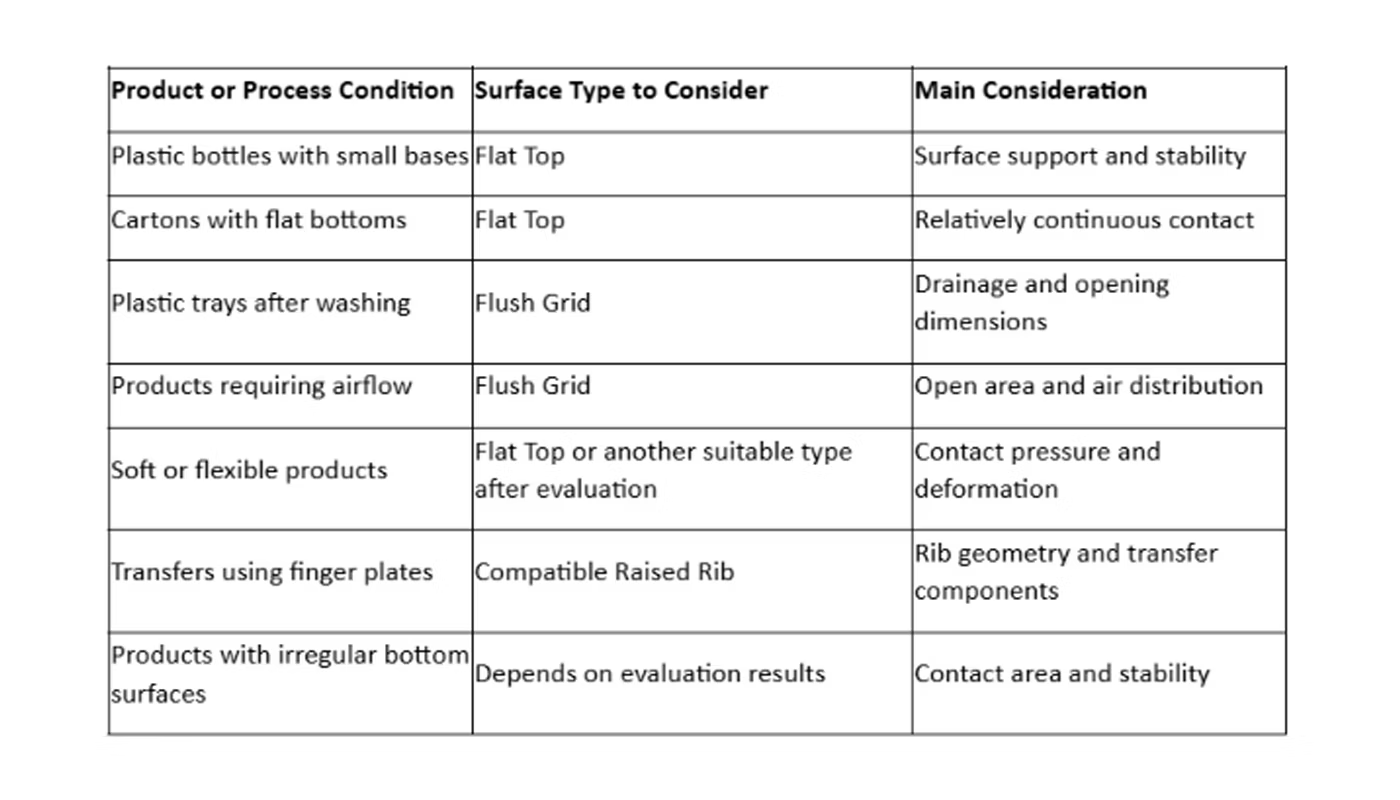
These examples provide initial selection guidance rather than universal recommendations. For certain applications, testing actual products on the proposed modular belt can help confirm suitability before final specifications are established.
7. Common Modular Belt Selection Mistakes and Conclusion
Selecting a modular belt based only on its visible surface design does not always result in the most suitable conveyor configuration. Several common mistakes should be avoided.
Common Mistakes When Selecting Modular Belt Surfaces
- Assuming all modular belts have similar surface characteristics : Flat top, flush grid, and raised rib belts provide different product support patterns and operating characteristics.
- Using flush grid belts without considering product dimensions : Openings that are too large relative to the product's supporting surface may reduce stability or cause products to become caught.
- Assuming flat top belts are always more hygienic : Cleanability also depends on hinge design, cleaning accessibility, residue characteristics, and sanitation procedures.
- Confusing raised rib belts : with friction top or cleated belts Raised rib construction does not automatically provide increased grip or product retention on inclined conveyors.
- Selecting belt surfaces based only on industry type : Two products within the same industry may require different modular belt surfaces because their physical characteristics and processing requirements differ.
- Overlooking product transfer requirements : Transfer gap dimensions and conveyor discharge configurations can significantly influence product stability.
- Ignoring component compatibility : Belt pitch, sprockets, wear strips, and transfer components must be compatible with the selected modular belt series.
- Failing to verify material operating limits : Modular belt materials have specific limitations related to temperature, loading, and chemical exposure. These specifications must match the operating environment.
Conclusion
Flat top, flush grid, and raised rib modular belts have different surface characteristics and are suited to different product handling requirements.
Flat top belts provide a relatively continuous supporting surface, making them a suitable option for products requiring stable, even support.
Flush grid belts feature openings that allow liquids and air to pass through, making them useful for certain washing, draining, cooling, and drying processes.
Raised rib belts feature elevated ribs that create a different product contact pattern. Certain belt series also support finger transfer plate applications.
However, no single modular belt surface is best for every application. The appropriate selection depends on product dimensions, shape, surface condition, drainage requirements, cleaning procedures, and transfer configuration.
The right modular belt is not simply one that can transport the product, but one whose surface characteristics match the requirements of the production process. Understanding the differences between these three surface types helps engineering teams make better-informed modular conveyor selections before finalizing system specifications.
Discuss Your Modular Belt Conveyor Requirements with Connect Automation
Connect Automation provides modular conveyor solutions for transporting products across a wide range of industrial production processes.
Selecting the appropriate modular conveyor requires consideration of product type, dimensions, weight, drainage requirements, operating environment, and downstream transfer methods.
Contact the Connect Automation team to discuss conveyor configurations suited to your production requirements.
Explore Connect Automation's Conveyor Products and Solutions
Connect Automation specializes in providing automation solutions, including conveyor systems, to improve efficiency across various industries. The company delivers cutting-edge technology to help organizations automate tasks and optimize workflows. Connect Automation helps businesses reduce manual efforts, boost productivity, and achieve better outcomes. With a customer-focused approach, the company designs tailored solutions to ensure smooth and effective automation transitions for long-term success.
Kawasan Industri Jababeka Tahap 1, Jl. Jababeka II D Blok C14L Cikarang, Indonesia (17530)
(021) 893 5060 Google Maps
Rungkut Industri III, No. 37, Rungkut Menanggal, Kec. Gn. Anyar Surabaya, Indonesia (60293)
(031) 9985 8624 Google Maps