REQUEST A FREE ESTIMATE!
Belt Conveyors for Electronics Industry and ESD Protection
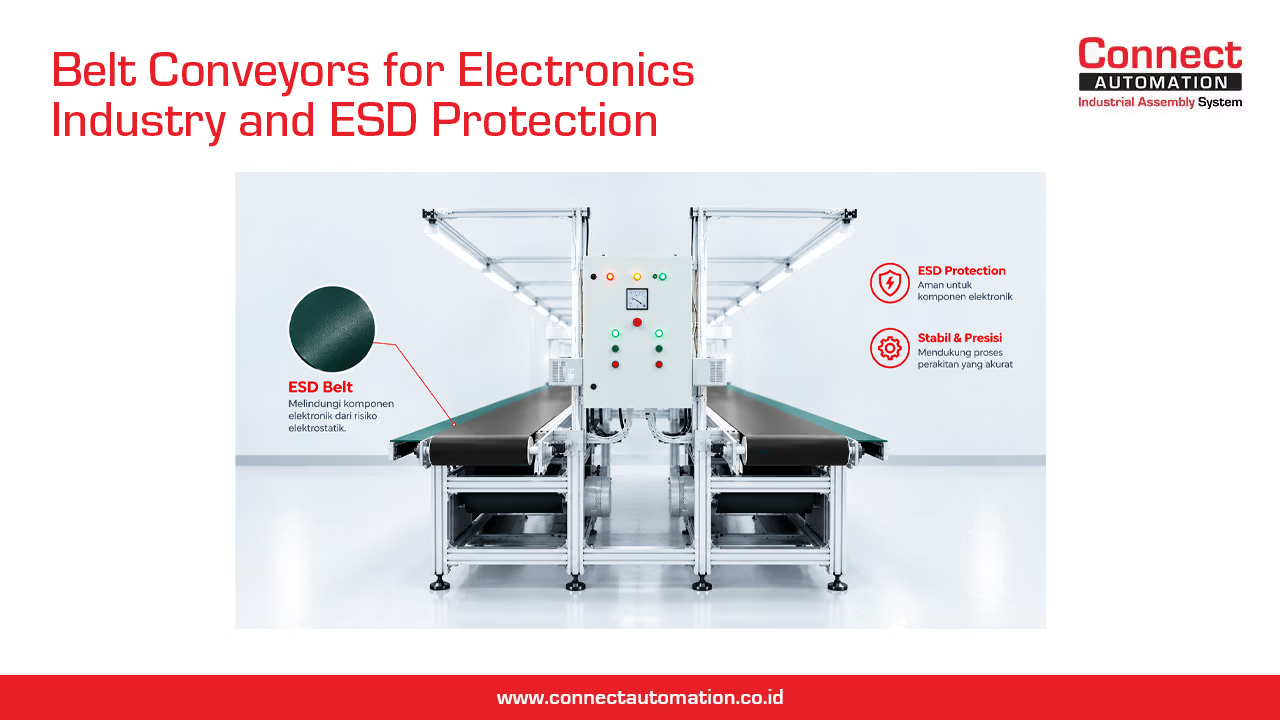
The electronics industry requires a well-organized production flow, from assembly and inspection to testing and packaging. Components and finished products need to move between processes with proper handling to support consistent and efficient production.
A Belt Conveyor for the electronics industry can serve as a product transfer system as well as an integral part of the production workstation. The conveyor can be combined with worktables positioned alongside the belt, allowing operators to perform assembly, inspection, and other processes directly along the production line.
For applications handling components that are sensitive to static electricity, ESD (Electrostatic Discharge) protection is also an important consideration when designing the conveyor and workstation.
The Role of Belt Conveyors in Electronics Manufacturing
Belt conveyors are used to transport electronic components and products from one production process to another.
In a production line, the conveyor can connect several stages such as:
Assembly → Inspection → Testing → Packaging
With a conveyor system, products can move continuously along the production line according to the required production sequence.
Beyond product transfer, the conveyor can also be designed as part of an operator workstation. Worktables can be positioned alongside the conveyor, allowing assembly or inspection activities to be performed directly at designated workstations.
Belt Conveyor Applications in Electronics Production
Conveyor requirements can vary depending on the production process. Common applications include:
1. Assembly
During assembly, components or products can be transferred from one workstation to another.
Operators can take products from the conveyor, perform the required assembly process, and then pass them to the next stage.
This configuration allows the conveyor and workstations to function as an integrated production flow.
2. Inspection and Quality Control
After assembly, products can be transported to an inspection area.
A workstation positioned alongside the conveyor can provide a dedicated area for visual inspection and other quality control activities required by the production process.
3. Testing
The conveyor can also connect the assembly process with a testing station.
Products can move to the testing area after assembly and then continue to the next production stage once the testing process is completed.
4. Packaging
After passing through assembly, inspection, and testing, products can be transported by conveyor to the packaging area.
This allows the belt conveyor to become part of the overall production flow rather than being used only for a single production stage.
Belt Conveyor Integrated with Workstations
One configuration commonly used for electronics production lines is a belt conveyor integrated with workstations.
Worktables can be positioned alongside the conveyor, giving operators direct access to products as they move through the production line.
A simple configuration can look like this:
[ Workstation ] | Conveyor | [ Workstation ]
Each workstation can serve a different function depending on the production process. One workstation may be used for assembly, another for inspection, and another for a different production operation.
In this configuration, the conveyor acts as the main transfer path connecting multiple workstations within the production line.
The worktable design can also be adjusted to suit the production process and operator position, allowing the conveyor and workstation layout to follow the requirements of the production area.
Why Is ESD Important for Electronics Conveyors?
In addition to product transfer requirements, electronics manufacturing has specific considerations related to electrostatic discharge (ESD), particularly when handling electronic components that are sensitive to static electricity.
ESD can be an important consideration during handling, assembly, inspection, and testing of products or components that require protection against electrostatic discharge.
For applications handling ESD-sensitive components, the conveyor and workstation should therefore be designed with the ESD requirements of the overall work area in mind.
ESD protection is not limited to a single conveyor component. Depending on the application, the overall system may need to consider the workstation, work surface, conveyor, and other elements directly involved in product handling.
ESD Conveyor and Workstation as an Integrated System
ESD Conveyor and Workstation as an Integrated System
For example:
ESD Workstation → Conveyor → ESD Workstation → Testing → Packaging
With this configuration, the conveyor becomes part of an integrated production workstation system designed to support electronic component handling.
ESD requirements can be considered during the design stage so that the conveyor and workstation configuration can be aligned with the needs of the production line.
This becomes particularly important when a production line contains multiple workstations with different processes while maintaining a controlled and organized product flow.
Product Handling on Electronics Belt Conveyors
Electronic products can vary significantly in size, shape, and weight. These characteristics should therefore be considered when designing the conveyor. Important considerations may include:
- Product dimensions and weight
- Product shape
- Product surface
- Product positioning on the belt
- Conveyor speed
- Spacing between products
- Guide or side guide requirements
- ESD requirements for sensitive components
The belt and conveyor configuration can then be selected according to the product characteristics and production requirements.
How to Choose a Belt Conveyor for the Electronics Industry
Not every electronics production line requires the same conveyor configuration. The system should be designed according to the product, production process, and facility layout.
Several factors should be considered.
- Production Capacity : The number of products that need to be handled within a specific period will influence the required conveyor capacity and speed.
- Conveyor Speed : Belt speed should be matched to the processes before and after the conveyor, particularly when the conveyor is part of an assembly or testing line.
- ESD Requirements : If the production line handles components that are sensitive to electrostatic discharge, ESD requirements should be considered from the beginning of the design process.
- Workstations : The number of workstations, type of operations, and operator positions should be considered so that the worktables and conveyor can be properly integrated.
- Production Line Layout : Conveyor length, machine positions, workstation spacing, and working height will all influence the overall conveyor and workstation configuration.
Customizing the Conveyor to the Production Line
One of the advantages of a conveyor designed around the production requirements is that its configuration can be adapted to the existing production flow. The conveyor can be designed to:
- Connect multiple workstations
- Match the required working height
- Integrate with worktables
- Connect with production machines
- Match conveyor speed with production flow
- Incorporate sensors or control systems when required
This means the conveyor does not have to function as a standalone unit. It can be designed as an integrated part of the overall production line.
Example of a Belt Conveyor Flow in Electronics Manufacturing
A simple production flow may look like this:
Component Loading → Assembly Workstation → Inspection Workstation → Testing → Final Inspection → Packaging
In this configuration, the belt conveyor provides the product transfer path between processes, while workstations are positioned according to the requirements of each operation.
For applications requiring ESD protection, ESD requirements can be incorporated into the relevant workstation and conveyor elements based on the requirements of the production process.
What to Consider Before Building an Electronics Conveyor
Before determining the conveyor design, it is useful to prepare the following information:
- Product or components to be conveyed
- Product dimensions and weight
- Production capacity
- Required conveyor speed
- Conveyor length and width
- Number of workstations
- Process performed at each workstation
- Worktable requirements
- ESD requirements
- Integration with machines or other equipment
- Production line layout
These details help determine a conveyor and workstation configuration that fits the production requirements.
Belt Conveyor for Electronics Production Lines
A Belt Conveyor for the electronics industry can be designed to do more than simply transfer products. By integrating conveyors, workstations, and ESD protection, the system can support different stages of electronics production, including assembly, inspection, testing, and packaging.
Every production line has its own requirements. Conveyor design should therefore consider product characteristics, production capacity, conveyor speed, ESD requirements, workstation configuration, and the overall production layout.
With the right configuration, a belt conveyor can become an integrated part of an electronics production line, supporting both product flow and operator activities throughout the manufacturing process.
Connect Automation specializes in providing automation solutions, including conveyor systems, to improve efficiency across various industries. The company delivers cutting-edge technology to help organizations automate tasks and optimize workflows. Connect Automation helps businesses reduce manual efforts, boost productivity, and achieve better outcomes. With a customer-focused approach, the company designs tailored solutions to ensure smooth and effective automation transitions for long-term success.
Kawasan Industri Jababeka Tahap 1, Jl. Jababeka II D Blok C14L Cikarang, Indonesia (17530)
(021) 893 5060 Google Maps
Rungkut Industri III, No. 37, Rungkut Menanggal, Kec. Gn. Anyar Surabaya, Indonesia (60293)
(031) 9985 8624 Google Maps